


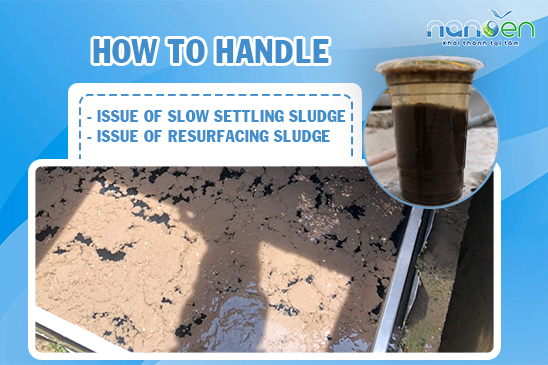
So what causes the phenomenon of difficult settling sludge and sludge floating back up? How can these causes be addressed? Let's explore the details together with Nanoen in the article below!
1. ISSUE OF SLOW SETTLING SLUDGE
1.1 Recognizing signs of slow settling sludge:
-
Fine sludge settles slowly;
-
Yellowish foam forms on the surface, and settling is slow.
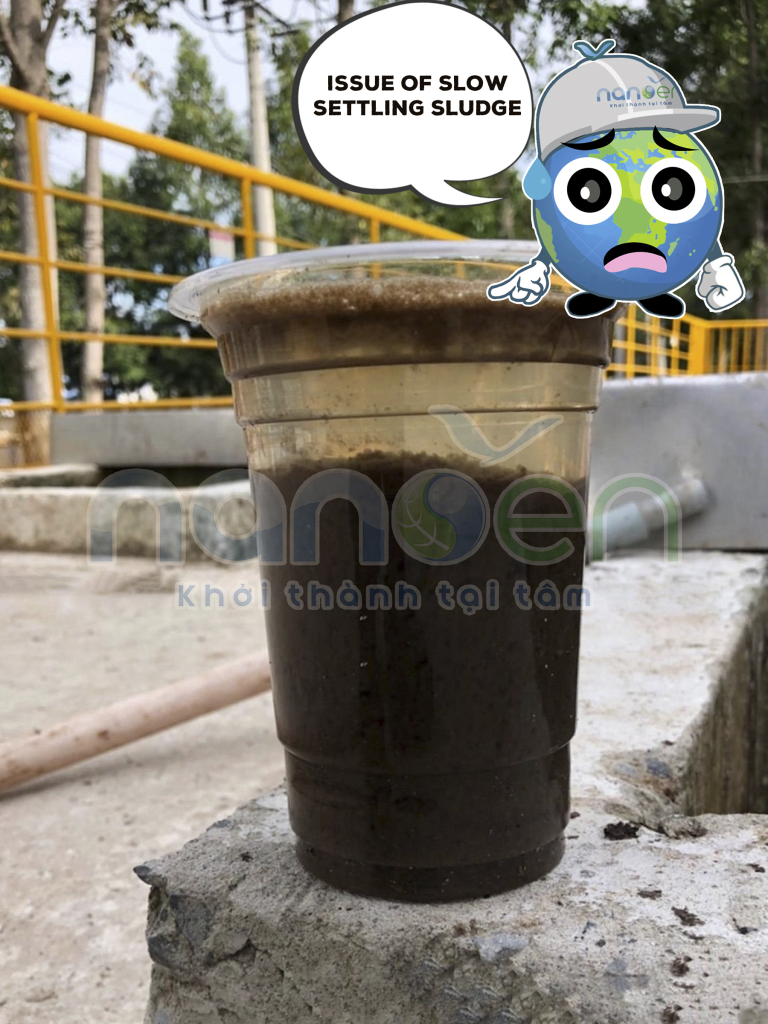
Slow settling sludge issues
(Source: Nano Environmental Company; Photo taken from actual field site)
1.2 Causes of Slow settling sludge issues
When the F/M ratio is low, it leads to excessive growth of filamentous microorganisms, forming network structures for solid particles to adhere to. Additionally, if the influent wastewater contains a high concentration of oils and fats, it also contributes to the growth of filamentous microorganisms.
The physical and chemical properties of the influent wastewater include fluctuations in flow rate, pH, temperature, nutrients, and the nature of the substrates.
Limitations in the design process include gas supply capacity, clarifier design, limitations on return sludge pump capacity, short-circuiting, and poor mixing.
Operational issues include incorrect organic loading rates, excessive aeration, or the presence of toxic substances.
Read more: Common problems of wastewater treatment systems
1.3 Remedies for Sludge Settling Issues
Remedies for filamentous microorganism-induced sludge settling issues:
-
If the F/M ratio is low, it is advisable to rebalance the F/M ratio accordingly.
-
In urgent cases, chlorine can be used in the return sludge at a dosage of 2 – 3 mg/L for every 1,000 mg/L of MLVSS. For severe cases, a dosage of 8 – 10 mg/L for every 1,000 mg/L of MLVSS may be necessary. Note: Chlorine treatment is effective only for filamentous sludge and may cause the effluent to become turbid until the filamentous microorganisms are eliminated.
-
If DO < 1 mg/L, increase aeration.
-
If the pH at the biological cluster is low or high, maintain the pH around 7.
-
Supplementation of deficient nutrients based on the ratio of BOD : N : P : Fe = 100 : 5 : 1 : 0.5.
Remedies for physical and chemical characteristics of influent wastewater:
-
Regularly monitor the organic loading rate.
-
If there is a deficiency in nutrients N and P, additional nutrients should be provided to the influent wastewater.
-
For cases of excessively high or low pH, consider constructing additional equalization and neutralization tanks for the influent wastewater.
Remedies for design process issues:
-
If the clarifier design is inappropriate, system retrofitting may be necessary.
-
To avoid overload due to return sludge, halt the return sludge during peak loading periods of water or organic matter.
-
If there is insufficient "short-circuiting" in the mixing process, increase aeration levels and add additional water distribution baffles.
Remedies for operational issues:
-
Adjust the organic loading rate to appropriate levels.
-
Ensure aeration is within regulatory limits.
-
Construct additional equalization tanks and remove toxic substances from the influent wastewater.
Read more: Necessary requirements of wastewater treatment system operators
2. ISSUE OF RESURFACING SLUDGE
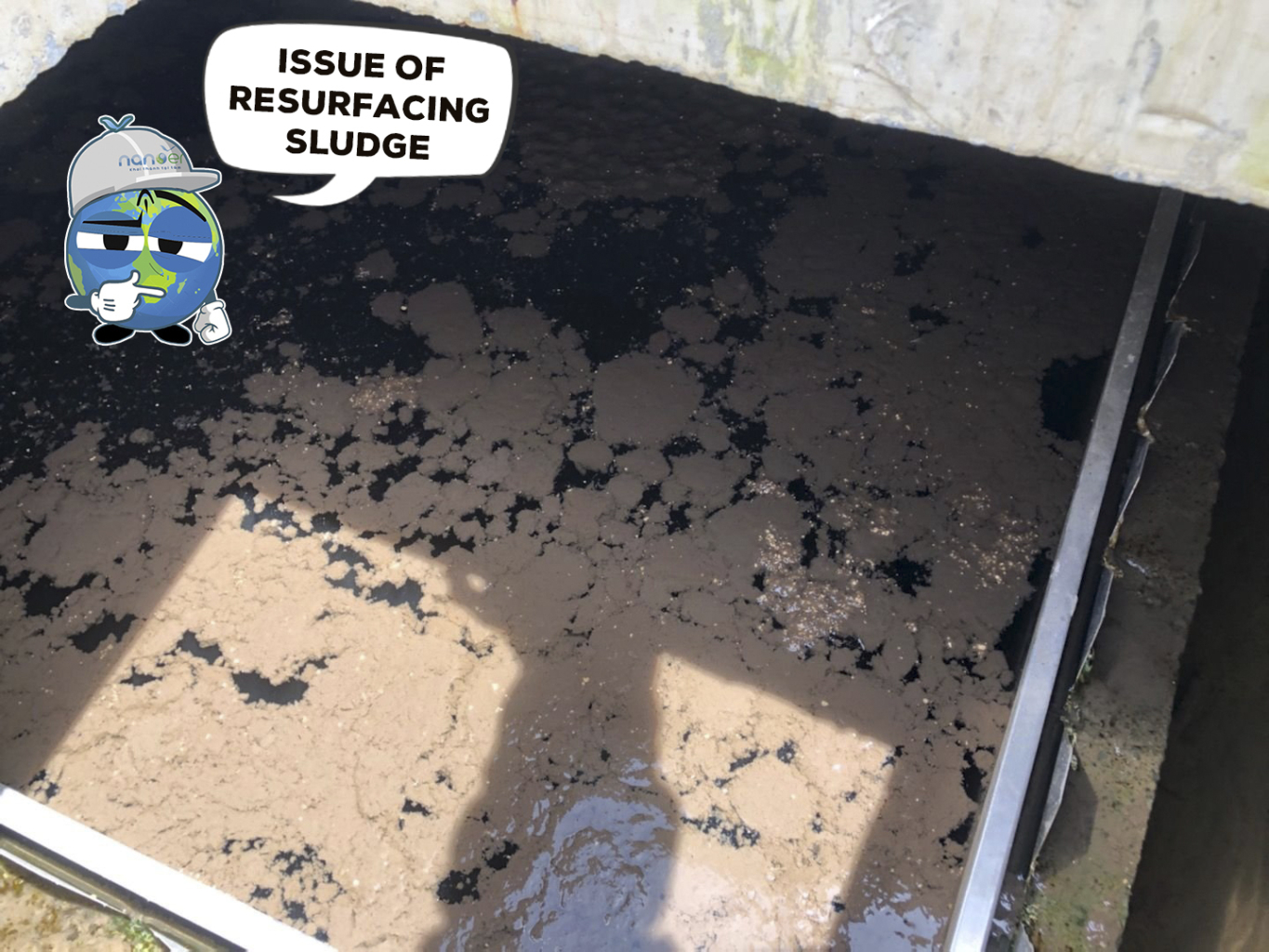
Issue of resurfacing sludge (Source: Nano Environmental Company; photo taken from actual field)
2.1 Causes of the Sludge Re-floating Issue
This phenomenon occurs due to the denitrification process of Nitrite and Nitrate at the bottom of the sedimentation tank. During this process, Nitrite and Nitrate in the wastewater will be converted into Nitrogen gas, which adheres to the sludge and creates buoyancy, pushing the sludge particles to the surface of the tank.
Additionally, the sludge re-floating issue can also be caused by sludge remaining at the bottom of the sedimentation tank for too long, leading to anaerobic decay underneath the tank, resulting in gas bubbles pushing the sludge upward.
2.2 Remedies for the Sludge Re-floating Issue
-
Increase the amount of return sludge to reduce the residence time of sludge in the sedimentation tank;
-
Increase the velocity of the sludge collection equipment in the sedimentation tank;
-
Reduce the average residence time of bacterial cells by increasing the amount of waste sludge discharged.
Through the information above, businesses can identify the causes of sludge settling difficulty and sludge re-floating. Based on the characteristics of each type of sludge, businesses can apply appropriate treatment methods to ensure that the effluent meets technical standards.
A reputable provider of environmental dossier services and construction, operation, maintenance, and servicing of wastewater treatment systems
Nanoen is a reputable provider of environmental dossier services and construction of wastewater treatment systems. Over the years, Nanoen has earned the trust of customers through honesty, dedication, and responsibility towards both customers and company products.
With experienced staff, Nanoen offers comprehensive services from environmental dossier consulting to design and construction, operation of environmental treatment systems, provision of microbial products, and sludge dewatering services.
Nanoen is committed to providing the best service experience tailored to the needs of customers.
Nanoen
Address: 661E/29, Vo Van Kiet Street, Binh Yen A Quarter, Long Hoa Ward, Binh Thuy District, Can Tho City
Hotline: 0941.777.519 - 0907.803.678 - 0901.229.798
Email: nanoentech@gmail.com
Facebook: www.facebook.com/nanoentech


