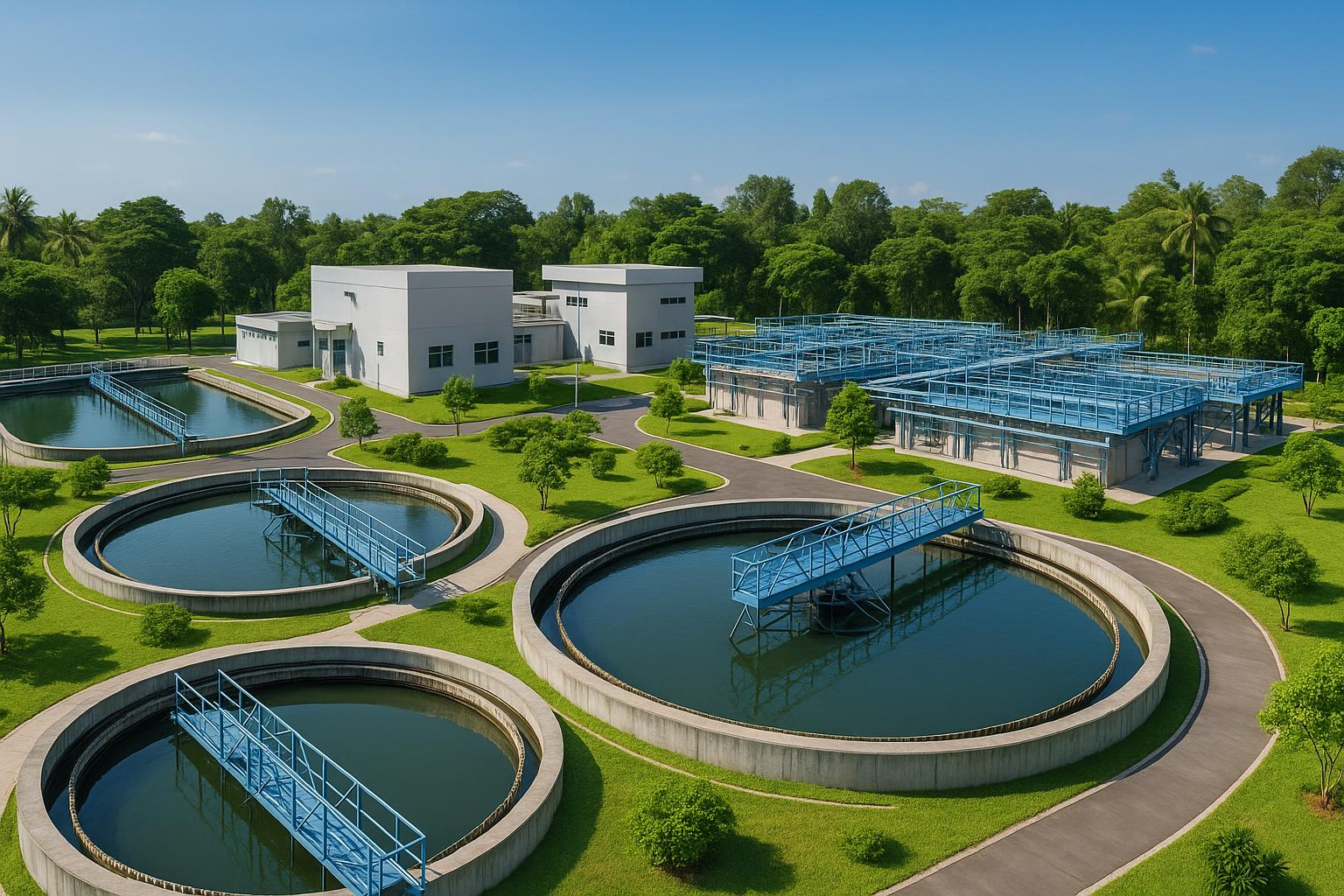
1. Specific Context of Domestic Wastewater Treatment Systems at Resorts
The domestic wastewater treatment station serving the resort seems "easier" than an industrial plant, but it has very characteristic fluctuations. The flow – load often spikes during peak hours (early morning, evening), weekends, peak tourist seasons, conference – wedding events, or promotional periods attracting large numbers of guests. In addition to traditional domestic wastewater from rooms, kitchens, and laundry areas, resorts also generate backwash water from swimming pools, water from cleaning beach – pool areas, which may carry excess chlorine, detergents, and fine sediments causing pH fluctuations, inhibiting microorganisms, and increasing suspended solids.
These fluctuations make the microbial ecosystem in the biological tank difficult to maintain a stable balance if the system lacks "buffers" such as balancing tanks, nutrient balancing, and good gas control – mixing. When the system cannot adapt in time, the effluent indicators often "swing": sometimes meeting, sometimes exceeding; electricity – chemical costs escalate; equipment overloads; unpleasant odors arise causing complaints from guests. Therefore, the renovation approach for resorts needs to prioritize the ability to absorb fluctuations (buffering) and smart operation rather than just increasing tank size.
Regarding construction progress, resorts can hardly stop operations for long periods. Therefore, renovation plans often have to be phased, "parallel" the new – old systems, avoiding service interruptions. This is an advantage of planned renovation compared to complete new construction in many contexts, as long as the tank structure and infrastructure are still good enough to continue operations.

2. Water Quality Goals and Compliance Framework for Domestic Wastewater
For resorts, the main type of discharge is domestic wastewater. Therefore, the technical standards to follow are QCVN 14:2008/BTNMT for domestic wastewater. At the same time, businesses should prepare a roadmap to meet the updated requirements of QCVN 14:2025/BTNMT issued under Circular 05/2025/TT-BTNMT. Aligning design – operation according to the appropriate standard group (domestic rather than industrial) helps select the right technology focus, avoiding excessive investment in unnecessary stages or missing characteristic indicators of domestic water.
In practical conditions, the requirement for "stable output" is not just a matter of completing legal documents; for resorts, it is also about guest experience: no odor, no scum, no unpleasant noise from machinery, no overflow incidents causing service interruptions. Therefore, the technical goals when renovating should include: maintaining DO levels in the aerobic tank sufficiently high, reducing TSS/COD fluctuations due to shock loads, controlling biological sludge for good settling, and increasing self-recovery capability after incidents. These goals closely align with the indicators, technical thresholds, and recommendations in operational practice that have been recorded.
3. Signs of System Overload or Deterioration: Early Detection to Avoid "System Failure"
3.1. Signs from Water Quality and Odor
When the effluent changes color abnormally (black, yellow, cloudy white) or appears with a lot of suspended solids, it is very likely that the biological system has lost balance, poor settling processes, or alternating old – young sludge. If the sludge turns black and settles poorly, it is a typical indicator of aerobic decline, dead microorganisms, and a shift to anaerobic decomposition; this is a series of incidents commonly recorded during renovations of old systems. If accompanied by a rotten egg smell (H2S), ammonia, or strong sour odors rising from the balancing, aerobic tanks, it is a red alert about a lack of dissolved oxygen, long-term sludge accumulation, or sudden organic shock loads.
In terms of quantitative thresholds, an important indicator is DO in the aerobic tank. When the measured DO is below 2 mg/l, the air bubbles are weak, unevenly distributed, and the aerator runs louder, the aerobic microbial community can rapidly decline, and the efficiency of organic matter treatment decreases sharply. This is a practical figure often used as a "red line" to trigger a rapid response process: checking the aerator, cleaning/replacing the air distribution disc, inspecting for air pipe leaks, and temporarily reducing the load if possible.
3.2. Signs from Equipment and Tanks
Submersible pumps – dosing pumps making strange noises, vibrating strongly, overheating, or flow dropping significantly are indicators of pump blade wear, debris entanglement, or damaged seals/bearings. If not addressed promptly, coil burning can cause line stoppages, leading to overflow in the balancing – settling tanks. On the aeration side, torn/clogged air distribution discs, dirty air filters reduce airflow, causing DO to drop quickly below safe thresholds. Additionally, leaks, cracks in concrete tanks due to foundation settlement or burst pipes under pressure can lead to untreated wastewater leaking into the soil – groundwater, creating significant risks for environmental incidents and the resort's image.
Some old stations have poorly designed piping, electrical cabinets that are hard to access for maintenance; old lamella settling systems may collapse or warp, increasing TSS in the effluent. These seemingly minor faults can be the root causes of the system consuming excessive electricity – chemicals, poor settling sludge, leading to a series of cascading incidents.
3.3. Signs from Operational Data
Even when visually observing the system as "smooth", rapid test data – internal monitoring can still raise alarms. When COD, BOD, ammonia, total nitrogen, phosphorus levels exceed the discharge limits applicable to domestic wastewater, a review of the entire process is necessary: balancing C:N:P nutrients, retention time, DO, sludge recirculation, dosing of settling – neutralizing chemicals. If the trend of exceeding occurs repeatedly, it is very likely that the technology/design flow is no longer suitable for the actual operation of the resort.
From a cost perspective, when electricity and chemical consumption per m³ increases abnormally, or the frequency of minor repairs rises, it is also an indicator that the system is working "over capacity" or is "patching up" rather than operating optimally. Experience shows that periodic maintenance costs can be only about 1/10 of repair costs when the system has completely collapsed; therefore, early detection for planned renovation – maintenance is a wise financial decision.
4. Assessment Process Before Deciding on Renovation
4.1. Survey – Analyze Flow and Quality
The first step is to survey "accurately and sufficiently": measuring flow hourly, sampling and analyzing influent – effluent wastewater over several days (especially during peak operational periods), checking operational – incident logs. Based on this, determine the degree of deviation between actual loads and the original design parameters, avoiding the situation of evaluating based on theoretical capacity, which often differs significantly from the peak operational figures of the resort.
Simultaneously, check the condition of construction items: tank structure (cracks, leaks), mechanical – electrical equipment (pumps, aerators, mixers, electrical cabinets), piping – valves – measuring instruments. Cleaning the trash screens, trash baskets, and removing accumulated sludge in the balancing/settling tanks before testing helps ensure operational measurement data aligns with "standard" conditions after basic maintenance.
4.2. Identify Root Causes – Avoid "Surface Fixes"
After obtaining data, analyze according to the cause – effect chain: microorganisms die due to low DO (weak aerators, clogged air discs), due to shock loads from kitchens/laundries, due to nutrient deficiencies; poor settling sludge due to filamentous bacteria (bulking), old sludge; poor coagulation – flocculation due to inappropriate dosing/conditions; damaged lamella; leaks – seepage causing localized electrical shorts. The correct approach is to adjust from the root: restore DO, balance nutrients, optimize retention – recirculation time, replace – rearrange weak equipment, rather than just increasing chemical doses or adding a supplementary tank "for the sake of it".
For resorts, the water source also includes backwash from pools containing excess chlorine, detergents; it is necessary to arrange or confirm the presence of appropriate neutralization/dilution units before directing to biological treatment. Otherwise, just one backwash can be enough to "burn" the biological tank, prolonging recovery time.
4.3. Develop Renovation Scenarios in Phases – Without Stopping the System
Once the root causes are clear, develop a phased renovation roadmap so that the resort does not have to halt services for long: install or upgrade "peripheral" equipment (pumps, aerators, electrical cabinets, pipes, valves) first; renovate tanks using a surrounding – temporary transfer method; run pilot tests; officially transfer when the new segment is stable. Implementing in parallel like this helps minimize interruptions – which is a key requirement in resort models.
In cases where the old system has severely deteriorated, technology is too outdated, or treatment demands have increased 2–3 times, the option of complete new construction is often more effective and sustainable in the long term. Conversely, when increasing capacity moderately (for example, from 500 to 700 m³/day or 1,000 to 1,300 m³/day) and the infrastructure – tank structure is still good, optimizing technology, adding essential processes often yields better investment – operational efficiency than complete new construction.
5. Typical Upgrade Solutions for Domestic Wastewater Treatment Stations at Resorts
5.1. Increase Moderate Capacity by Optimizing Existing Structures
When the demand does not increase too much (for example, from 500 to 700 m³/day, 1,000 to 1,300 m³/day), existing tanks can be utilized by: adding balancing tanks (if lacking), optimizing piping – pumps to reduce losses, increasing aeration – mixing efficiency, fine-tuning sludge recirculation, and adding finishing processes such as filtration – disinfection. This approach shortens timelines, reduces basic construction costs, and limits system shutdowns.
To absorb daily flow fluctuations, balancing tanks need to be fully utilized: operate pumps – mixers according to peak hour scenarios, cutting peak flows directed to the biological tank. At the settling tank, check lamella, collection – overflow pipes to ensure surface velocity and uniform distribution, avoiding fine sludge being carried out with the effluent.
5.2. Enhance Biological Efficiency and Stabilize Nitrogen Removal
Many old systems lack or have insufficient volumes of anoxic zones, leading to poor nitrogen removal when ammonia loads fluctuate. Renovation can be done by dividing existing tank compartments, arranging mixers – internal recirculation piping to create a denitrification loop. If sludge settles poorly due to bulking, it is necessary to re-establish sludge structure: assess SV30/SVI, balance nutrients, control DO in aerobic conditions, and eliminate inhibitory toxic sources such as excess chlorine from pool cleaning water through neutralization – dilution before biological treatment.
For resorts requiring compact space – low noise, consider upgrading aeration systems (fine air discs, evenly arranged), high-efficiency aerators, or adding microbial carriers to increase biological density within the same volume. The goal is to maintain DO always above the "warning line" of 2 mg/l in the aerobic zone during peak hours.
5.3. Add Coagulation – Flocculation and Physical Settling as Needed
When the effluent has many fine particles, high turbidity, or the biological settling tank struggles to achieve low TSS during peak hours, adding a coagulation – flocculation – physical settling line after biological treatment is a "shock absorber" solution. This line is also useful when the resort has sources of water from cleaning floors – pools that increase solids and cause pH fluctuations. It is necessary to arrange quick – slow mixing tanks appropriately, select – optimize coagulant/chemical dosing and physical settling as needed.
To close the loop, a dedicated physical settling tank should be added (if the biological settling tank cannot take on the role) to separate generated sludge. Optimal design will allow for "on/off" chemical treatment according to peak – low seasons, avoiding increased regular costs when not needed.
5.4. Upgrade Aeration – Mixing and Electrical – Control Systems
Aerators, air distribution discs, pumps – mixers are the "heartbeat" of the station. Replacing torn/clogged air discs, cleaning air filters, adjusting aerator capacity according to target DO, inspecting – replacing worn pumps, seals – bearings helps keep DO out of the risk zone below 2 mg/l and stabilize performance. Regarding control, review electrical cabinets, wiring, circuit breakers, relays, sensors; adding DO measurement – display in aerobic conditions is a small investment but prevents "information blindness" – a common cause of systems experiencing shock loads without knowing.
Finally, rearranging piping – valves according to the principle of easy access, clearly defined compartments for isolation – maintenance operations; adding waterproofing – corrosion protection for reused tanks. These "infrastructure" actions significantly impact long-term stability after renovation.
6. Costs: CAPEX – OPEX Analysis Framework and Key Figures to Know
For resorts, the decision to renovate – build new is not only about comparing initial investment costs (CAPEX) but also about operational costs (OPEX) over many years, risks of service interruptions, and future expansion capabilities. Practical experience shows that leveraging existing infrastructure (tanks, foundations, some piping – electrical cabinets) significantly reduces CAPEX and shortens timelines. When only a moderate capacity increase is needed (from 500 to 700 m³/day or 1,000 to 1,300 m³/day), clever renovations often yield better investment efficiency than complete new construction.
On the OPEX side, special attention should be paid to regular maintenance – upkeep rather than "waiting for it to break before fixing". In reality, periodic maintenance costs are only about 1/10 of repair costs when the system has collapsed (breakdown). Additionally, a correct approach from the start can save billions in cumulative total costs compared to "patching up" solutions over many years. For resorts, the economic value of "not interrupting service" is even greater than direct cost figures, as prolonged environmental incidents can severely impact guest experiences and brand reputation.
Therefore, the cost perspective should be based on the system's lifecycle: investing in core items that create differences for stability (balancing, aeration – mixing, settling, DO measurement, piping – electrical cabinet arrangement), and only adding chemical – filtration enhancements when operational data truly proves necessary. Optimizing the "cost drop-off" point is balancing compliance with current QCVN 14:2008/BTNMT, readiness for QCVN 14:2025/BTNMT, while keeping OPEX under control during peak – low seasonal operations.
7. Quantitative Indicators and Quick Response Directions in Renovation – Operation
| Indicator/Threshold | Technical Significance | Recommended Action | Data Source |
|---|---|---|---|
| DO in aerobic tank < 2 mg/l | Lack of oxygen; weakened aerobic microorganisms; risk of odor, reduced organic treatment efficiency | Check aerator, clean/replace air distribution disc, check for air pipe leaks; raise DO above 2 mg/l | Recorded operational practice |
| Effluent black/cloudy white; black sludge difficult to settle | Shock load, lack of oxygen; dead sludge – bulking; poor settling leading to high TSS | Optimize DO, balance nutrients; address bulking; check lamella, recirculate sludge | System renovation experience |
| Target capacity increase: 500 → 700 m³/day | Moderate increase, good infrastructure can be utilized | Prioritize renovation: optimize biological, aeration – mixing, settling; add balancing/completion if needed | Typical examples |
| Target capacity increase: 1,000 → 1,300 m³/day | Moderate increase; suitable for upgrading equipment and processes | Utilize existing tanks; add anoxic/coagulation – flocculation as needed | Typical examples |
| Demand increases 2–3 times capacity | Old system difficult to meet; patching complicates operation | Consider complete new construction for long-term stability | Implementation experience |
| Periodic maintenance costs ≈ 1/10 of breakdown repair costs | Early maintenance saves significantly; extends equipment lifespan | Establish a periodic maintenance plan, replace consumable parts on schedule | Cost experience |
8. Common Errors in Operation – Renovation and Prevention Methods
8.1. Microorganisms and Biological Processes
The most common error is mass die-off of microorganisms due to sudden load increases, DO dropping below safe thresholds, or nutrient deficiencies. At that point, sludge turns black, anaerobic odors appear, and nitrification stagnates. The remedy is to raise DO above 2 mg/l in aerobic zones, restore recirculation – sludge return, rebalance nutrient ratios, and if necessary, re-culture high-activity microorganisms. This should be done after eliminating toxic agents (e.g., excess chlorine from pool cleaning water, strong detergents), otherwise the biological tank will continue to "burn".
The phenomenon of floating sludge – poor settling (bulking) is also very common after half-hearted renovations. The causes are often due to lack of DO control, unbalanced nutrients, or incorrect sludge recirculation modes. The solution is to adjust DO, nutrients, and if necessary, apply short-term (chemical) solutions to lower TSS during the biological recovery phase, combined with changing unfavorable conditions for filamentous bacteria.
8.2. Mechanical – Electrical and Technology Layout
Deteriorated equipment that is not regularly maintained leads to increased noise, vibration, overheating; over time, this causes motor burns and shaft jams. These failures lead to drops in DO, pipe blockages, and tank overflows. The remedy is to establish a specific maintenance – upkeep schedule, stock essential spare parts (air discs, bearings, pump seals), assign responsible points of contact, and conduct regular inspections. Additionally, layout piping – valves – electrical cabinets scientifically to facilitate isolating each compartment during maintenance, reducing the risk of incident spread.
In the settling block, aging – collapsing lamella, clogged collection – overflow pipes not only increase TSS but also cause "shocks" to subsequent processes. In renovations, the "rejuvenation" of settling should be a focus: replace – reinforce lamella, optimize flow distribution, and provide a bypass channel when maintenance is needed.
8.3. Data Management and Load Control
Many stations "operate in the fog" due to a lack of basic data: no DO readings, no periodic rapid tests of key indicators, no operational – incident logs. In such cases, decisions are often based on intuition; the system struggles to stabilize. Immediately supplement essential measurement points (especially DO in aerobic conditions), establish rapid testing frequency, and record logs as foundational steps for data-driven management.
On the other hand, resorts have shock load sources (pools, laundry, kitchens) that require batch discharge procedures, neutralization – dilution, or appropriate flow diversion. Coordination between station operations and service departments in the resort (pool discharge schedules, large laundry schedules…) is a "plus point" that helps the biological system not be caught off guard.
9. Maintenance Plan After Upgrading: Locking in Efficiency and Costs
After renovation, maintaining regular maintenance is a crucial defense line. The plan should include: cleaning the system (removing debris, washing membranes if any, flushing carriers), dredging balancing – settling tanks according to appropriate cycles, maintaining mechanical – electrical systems (greasing bearings, replacing air filters, checking motor insulation, replacing torn/clogged air discs), and calibrating sensors – measuring instruments. This has much lower costs than allowing incidents to accumulate into a "break point", which, according to experience, is only about 1/10 of repair costs when the system has collapsed.
In biological terms, maintaining appropriate sludge concentration – sludge recirculation, monitoring settling indicators (SV30, SVI), and observing sludge structure under a microscope helps predict bulking/aging trends early. If the system has previously experienced shock loads, supplementing – enhancing high-activity microorganisms can help recover faster; in many cases, the desired state can be achieved after about a week when conditions are well controlled. On that basis, the system will stabilize, consume electricity – chemicals reasonably, and maintain effluent quality meeting discharge requirements for domestic wastewater according to current regulations, ready for future updates.
FAQ
-
When should renovation be chosen instead of new construction for the resort's treatment station?
If the tank – infrastructure structure is still good and the capacity increase demand is only moderate (for example, from 500 to 700 m³/day or 1,000 to 1,300 m³/day), renovation is often more cost-effective and timely. Conversely, when needing to increase capacity by 2–3 times or the old system is severely deteriorated, complete new construction helps stabilize in the long term.
-
What signs indicate that the system is lacking oxygen and needs immediate intervention?
DO levels in the aerobic tank below 2 mg/l, weak – uneven air bubbles, and water with anaerobic odors are typical warnings. It is necessary to check the aerator, clean/replace the air distribution disc, fix leaks, and raise DO above safe thresholds.
-
How to minimize interruptions during renovation while the resort is still operating?
Divide construction phases: install – upgrade peripheral equipment first, surround and renovate tanks in segments, run parallel tests, then officially transfer when the new segment is stable. This approach helps the resort avoid long service interruptions.
-
Are periodic maintenance costs worth it compared to "waiting for it to break"?
Yes. Practical experience shows that periodic maintenance costs are only about 1/10 of repair costs when the system has collapsed. Maintenance also helps extend equipment lifespan and keep effluent stable, avoiding environmental incident risks.
-
If the sludge turns black and settles poorly, what direction should be taken?
This is a sign of aerobic decline/shock load. Raise DO above 2 mg/l, balance nutrients, adjust recirculation – sludge return, check lamella – settling. In many cases, it is necessary to enhance microbial cultures after eliminating inhibitory agents such as excess chlorine.
-
What standards apply to the domestic wastewater of resorts?
Resorts treating – discharging domestic wastewater should base on QCVN 14:2008/BTNMT and prepare a roadmap to meet QCVN 14:2025/BTNMT under Circular 05/2025/TT-BTNMT. The design – operation must closely follow the domestic standards to ensure compliance.
Nanoen
NANO THANG LONG ENVIRONMENTAL COMPANY LIMITED
Hanoi Office: No. 15 TT18 Van Phu Urban Area, Ha Dong, Hanoi
Can Tho Office: 661E/29, Vo Van Kiet Street, Binh Yen A Area, Long Hoa Ward, Binh Thuy District, Can Tho City
Ho Chi Minh City Office: 533/12/7, Pham Van Bach Street, Ward 15, Tan Binh District, Ho Chi Minh City
Hotline: 0986.689.781 - 0969.054.226
Email: thanglongnanoen@gmail.com
Facebook: www.facebook.com/thanglongnanoen