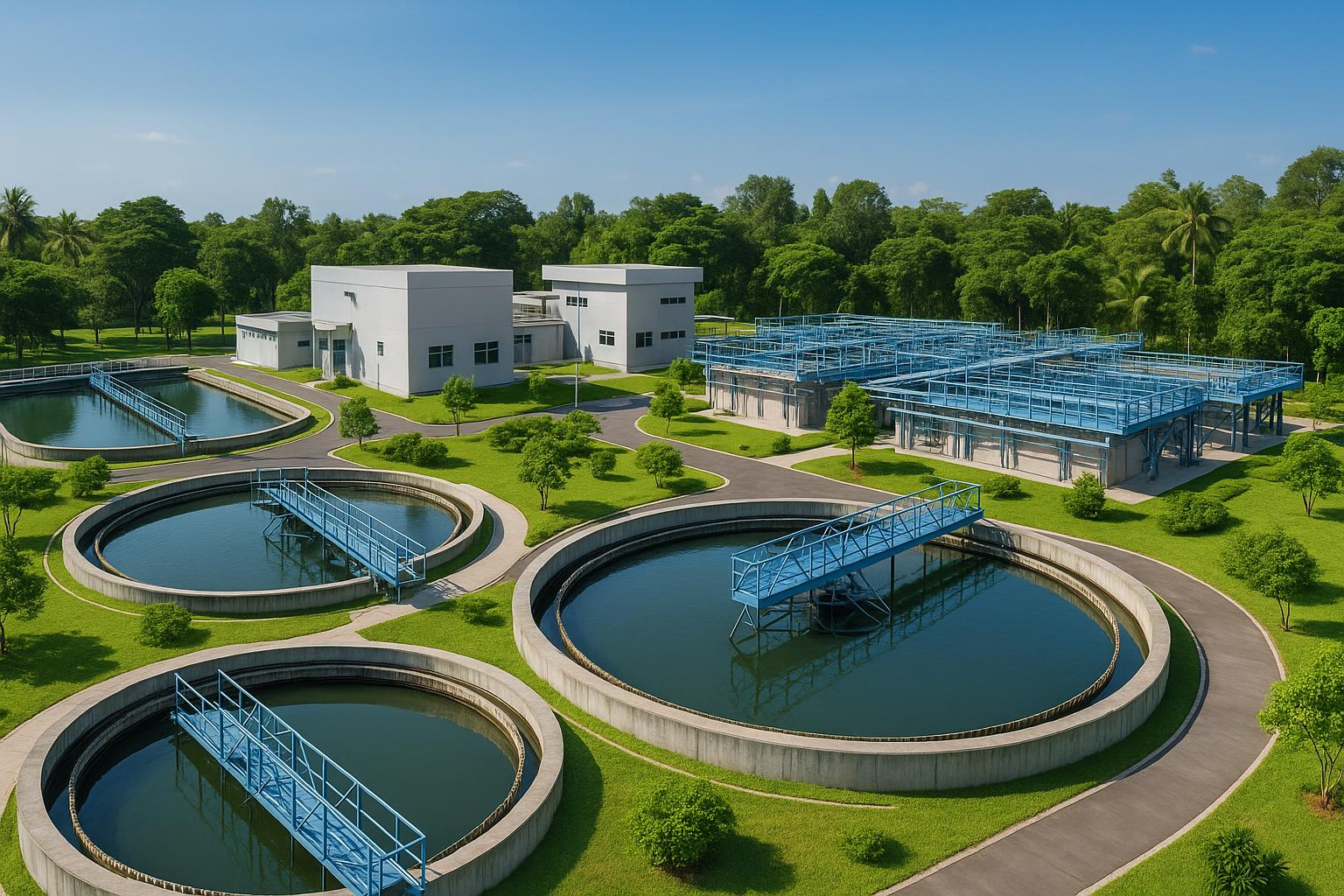
1. Why regular maintenance of pump equipment is the "backbone" of wastewater treatment plants
In most industrial wastewater treatment plants, pumps are the link that keeps the entire process in rhythm: from the collection pit – equalization tank – biological clusters – sedimentation – sludge treatment and even chemical dosing. A pump that loses efficiency or stops suddenly will lead to a chain of consequences: unbalanced water levels, fluctuating biological sludge, aerators and mixers operating under load, and the risk of non-compliant effluent. From a risk management perspective, regular maintenance helps to "cool down" potential bottlenecks, increase equipment readiness, and maintain operational safety margins.
For pumps, failure mechanisms typically develop over time: worn seals lead to leaks, dry bearings cause noise – vibration, broken or clogged impellers reduce flow, and deteriorating insulation can easily lead to short circuits. These symptoms can all be detected early through systematic inspections and scheduled measurements. For example, monitoring the working current of the pump motor monthly helps to identify abnormal load imbalances early, allowing for proactive repair planning instead of waiting for a breakdown (refer to the monthly current measurement schedule in the source document).
In addition to reliability, maintenance helps extend the lifespan of pumps and optimize energy consumption. A pump that is always clean, properly aligned, has sealed seals, and well-lubricated bearings will consume significantly less electricity than a "fatigued" pump, while also reducing the risk of production line stoppages. Field experience shows that many major incidents actually originate from very small signs such as a slight squeal, unexplained current spikes, or a few drops of water leaking at the seal – all of which can be prevented by a regular maintenance program and thorough record-keeping.

2. Identifying pump groups in wastewater treatment plants and specific risks
In the raw wastewater and sludge layer, centrifugal wastewater pumps and submersible pumps handle large flows, moderate to low pressure, and high concentrations of suspended solids. Typical risks include clogging from debris causing increased electrical load, impeller wear leading to reduced flow, cavitation when air intake is blocked, or excessive suction loss. Submersible pumps, which operate continuously in wet pits, accumulate dirt on the casing and cooling components, necessitating regular cleaning and serious insulation testing to avoid electrical discharge to the casing.
In the chemical dosing line, metering pumps have a small stroke but require high accuracy. Deviations in chemical dosing directly affect the biological-chemical balance of the system: nutrient deficiencies weaken the sludge, overdosing of coagulants causes abnormal floc formation, or excessive oxidizing agents kill microorganisms. For gear-driven metering pumps, managing gearbox oil, cleaning the suction – discharge lines, and proper startup procedures are three pillars to maintain accuracy and longevity.
Electrical and control risks cannot be overlooked. At the electrical cabinet and power circuits, loose terminals, poor grounding, degraded insulation, or voltage deviations from the allowable range can easily cause overheating, voltage drops, tripped circuit breakers, or equipment failure. Practicing voltage, current, noise, insulation, and cabinet cleaning checks significantly reduces the risk of machine stoppages due to electrical faults (quantitative thresholds are referenced from the sources in the following section).
3. Regular maintenance procedures for pump equipment by application type
3.1. Centrifugal and submersible wastewater pumps
Before performing any operations, always ensure electrical – mechanical safety: disconnect power, hang warning tags, and close related valves to avoid hydraulic shocks on the piping. For submersible pumps, never use power cables to lift the pump; if the equipment weighs over 30 kg, a hoist must be used to lift it out of the pit; under 30 kg can be lifted by hand but still requires proper hanging straps to avoid damaging the shaft and pump casing. Correct lifting rules help minimize shaft bending and cable breakage – a subtle but common cause of abnormal vibrations after reinstallation.
After cleaning the pump body and impeller chamber, manually rotate the shaft to check for smoothness. If you hear a squeal or feel friction, disassemble to check the impeller, bearings, and seals. Unusual noise during operation often suggests dry or damaged bearings; in this case, the machine should be stopped and the bearings replaced promptly to avoid "burning" the bearing and damaging the shaft. Water leakage at the seal, damp streaks, or continuous dripping in the seal area indicates worn – cracked seals; the solution is to replace the seals with new ones, avoiding excessive tightening that can deform the seal face.
Electrical – safety checks must be performed systematically. Measure the operating current of the motor monthly to compare with the normal level for the same load; increased current with decreased flow often signals impeller blockage or debris clogging. At the electrical cabinet, monitor the overall noise level of the system and machinery not exceeding 80 dB; this is a quick indicator of abnormal vibration – noise and occupational safety. Electrical equipment should also achieve a minimum insulation resistance of approximately 0.1 MΩ when measured between phases and between phase – casing; low values increase the risk of electrical leakage, especially for submersible pumps placed in damp environments. Additionally, maintaining the operating voltage within ±10% of the rated value and ensuring line voltage drop does not exceed 2% per 100 V helps keep the power circuit operating "cool" and prolongs the lifespan of switching components.
3.2. Chemical metering pumps
For gear-driven metering pumps, managing lubrication oil is crucial. After accumulating 6000 hours of operation, change the oil in the gearbox once, thoroughly drain the old oil, and refill to the red mark on the sight glass; never operate when the gearbox is low on oil. Simultaneously, clean the suction – discharge heads and piping monthly to prevent clogging from deposits or crystallized chemicals; this is a common cause of overload, joint breakage, or dosing flow deviations.
Starting metering pumps correctly helps preserve seals – membranes and ensure accurate calibration. When starting for the first time (or after major maintenance), set the flow adjustment knob to about 20% and hold for 3–5 minutes to allow the system to stabilize, eliminate air bubbles, and balance pressure. Then gradually increase to working flow. During the initial test, compare the displayed pressure with the gauge and ensure the operating pressure does not exceed the maximum pressure indicated on the pump's power label. Before running, confirm that all On/Off valves in the suction – discharge line are open, chemicals in the pipes are not frozen – caked, and the motor rotation matches the arrow on the machine body.
Basic electrical – mechanical operations include checking tightness of connections, condition of power – signal wires, measuring insulation, cleaning the pump surface and installation area to avoid vibration transmission. If the pump produces a "knocking" sound or shakes violently at the base, immediately check the machine foot bolts, support frame, and the rigidity of the flexible hoses in the suction – discharge lines; metering pumps operating in loose foundations are very likely to "eat" membranes – seals quickly.
3.3. Checking the electrical – control system supplying the pump
At the electrical cabinet, check protective devices such as relays, contactors, circuit breakers, tighten connections, and clean the cabinet to remove dust – a factor that increases the risk of overheating and electrical discharge. Measure voltage and current at each power circuit; maintain actual voltage not exceeding ±10% of the value indicated on the equipment label and control line voltage drop at no more than 2% per 100 V. For critical lines, it is advisable to include measuring current – voltage – temperature at terminals in the periodic inspection checklist to identify poor contacts early.
Measure insulation resistance between phases and between phase – casing, achieving a minimum of approximately 0.1 MΩ before re-energizing after wet maintenance or cleaning. Record noise levels when the cabinet is operational; keeping system and machinery noise levels not exceeding 80 dB ensures occupational safety and serves as an indicator for abnormalities such as vibrations, cabinet fan noise, or continuous contactor operation. Finally, clean ventilation, check grounding, and neatly arrange wiring for easier monitoring during future inspections.
4. Parameters to monitor during pump operation and control thresholds
In terms of electricity, three fundamental parameters to monitor are supply voltage, operating current, and insulation resistance. Maintaining voltage within the allowable range, not exceeding 10% of the rated value, will help the motor maintain insulation and avoid abnormal heating; controlling line voltage drop to no more than 2%/100 V is a measure to reduce losses and "insure" switching equipment. Measure the pump motor current monthly to compare with the "fingerprint" of normal operation for each pump; when current increases while flow decreases, prioritize checking for impeller blockage, suction line clogging, or increased friction at seals. Before allowing the equipment to return to operation after wet maintenance, measure insulation resistance of at least approximately 0.1 MΩ between phases and phase – casing to eliminate the risk of electrical leakage.
In terms of mechanical – hydraulic aspects, monitor pressure and working flow of the pump to ensure they do not exceed the rated values published by the manufacturer. For metering pumps, during trial runs, set the stroke to approximately 20% for 3–5 minutes before gradually increasing, while checking the pressure gauge to ensure actual pressure aligns with the pump's design range. In the field, noise is a visual indicator: the system and machinery should not exceed 80 dB; any sudden increase in noise levels warrants stopping the machine to check bearings, alignment, and impeller condition.
Regarding pipeline – material preservation, clean the suction – discharge lines of metering pumps monthly to eliminate deposits; for wastewater pumps, clean the trash baskets in the manholes and collection pits on schedule to reduce the risk of impeller clogging. It is advisable to maintain a log for periodic work milestones, such as changing the gearbox oil of metering pumps after every 6000 hours of operation, or measuring pump current monthly, to control the lifecycle of consumable materials.
5. Comparison table of maintenance schedules and core items by pump type
| Item/Cycle | Centrifugal/Submersible Wastewater Pump | Chemical Metering Pump |
|---|---|---|
| Measure motor current (periodically) | Monthly measurement; compare with normal indicators to detect debris blockage, flow reduction | Monthly measurement; identify valve blockage, overload stroke |
| System/machine noise | Should not exceed approximately 80 dB; increased noise suggests bearing/seal issues | Should not exceed approximately 80 dB; periodic noise requires checking base – stroke |
| Permissible voltage and voltage drop | Voltage should not exceed ±10% of rated; voltage drop should not exceed 2%/100 V | Voltage should not exceed ±10% of rated; voltage drop should not exceed 2%/100 V |
| Insulation resistance before re-energizing | Minimum approximately 0.1 MΩ (measured phase – phase, phase – casing) | Minimum approximately 0.1 MΩ (measured phase – phase, phase – casing) |
| Hydraulic cleaning | Regular cleaning of the pump body – impeller; clean trash baskets in collection pits | Clean suction/discharge lines monthly to avoid deposits |
| Oil change/gearbox | According to each pump's design; check the oil chamber if applicable | Change gearbox oil every 6000 hours; refill to the red mark on the sight glass |
| Lifting rules | Submersible pumps < 30 kg can be lifted by hand; ≥ 30 kg must use a hoist; do not pull with power cables | Ensure the base is stable, avoid vibrations transmitted to the pipe; do not operate when gearbox oil is low |
| Startup after maintenance | Bleed air, prime the pump if necessary; check for correct rotation direction | Run at ~20% flow for 3–5 minutes then gradually increase; do not exceed maximum pressure indicated on the pump |
6. Common pump issues and on-site diagnosis – troubleshooting
6.1. Leakage at seals, flanges, and damaged sealing seals
Early signs include damp streaks around the seal chamber, continuous dripping, or salt – dry residue after each shift. Worn, cracked seals or lost elasticity springs will not maintain optimal clearance, allowing water to seep into the bearing chamber, leading to noise – overheating. The solution is to stop the machine, disassemble for inspection, and replace seals with the correct material code; do not attempt to tighten to "fix" as the seal face will become jammed – scratched, causing heavier leakage when restarted.
For metering pumps, leakage can also occur from a torn diaphragm. When dripping is observed in the pump chamber or sudden flow drops occur while pressure fluctuates, check the diaphragm condition; replace it and recalibrate the stroke. Before closing the machine again, ensure all On/Off valves are open, and the pipes are free of debris to avoid abnormal pressure spikes upon startup.
6.2. Noisy – vibrating bearings, increased current causing overheating
Degraded bearings manifest through squealing, rumbling at rotational speed, and increased temperature at the bearing housing; over time, this will misalign the shaft, wear out seals, and reduce motor lifespan. During regular maintenance, after cleaning, manually rotate to check for smoothness, listening for any rubbing sounds. When noise is present, do not operate "through it" but replace bearings promptly; monitor operating current monthly to detect early cases of increased friction or impeller blockage causing high current.
Indirect causes of rapid bearing failure include misalignment, vibration transmission from the foundation, or piping exerting lateral forces on the shaft. After replacing bearings, thoroughly check machine foot bolts, support bearings, flexible hoses, and alignments – couplings; this is often overlooked but crucial for determining the time between repeat failures.
6.3. Impeller blockage, flow reduction, and pressure fluctuations
On the wastewater line, fibrous debris, plastic bags, rags… often cause impeller blockage. Symptoms include a noticeable drop in output flow, fluctuating discharge pressure, and increased motor current. The machine needs to be stopped, isolate the valve, remove the cover to inspect the impeller; regularly clean the trash baskets in the collection pits to cut off the source of debris. After reassembling, run a test and compare current – pressure with pre-failure data to confirm it has returned to normal levels.
For metering pumps, blockage due to crystallization in the suction – discharge lines also presents similar symptoms: reduced flow, erratic pressure increases, and fluctuating pressure gauges. Monthly cleaning of the lines will prevent most of these situations; if issues arise, flush the lines with appropriate solvents, and check the check valve and diaphragm – ball valve for debris buildup or misalignment.
6.4. Air-lock, cavitation, and priming difficulties
Open or elevated suction lines creating air bubbles will make it difficult for the pump to prime, causing flow "jumps" and noise. Check flanges, gaskets, tighten connections, and bleed air at the correct locations; for metering pumps, the startup procedure at around 20% for 3–5 minutes helps "push" air out of the measuring head and lines. Avoid having the suction line with bends or traps; maintain the liquid level in the suction pit appropriately to limit cavitation.
Prolonged cavitation causes impeller damage, pitting on the impeller surface, and significantly reduces performance. If you hear characteristic boiling – squealing sounds and see low suction pressure, review suction losses, adjust the pump's elevation, or reconfigure the suction line (diameter, bends, trash screens) to reduce losses and prevent air ingress.
6.5. Electrical issues: voltage drops, degraded insulation, protective devices tripping
Line voltage drops exceeding approximately 2%/100 V or supply voltage deviating more than 10% from the rated value will cause the power circuit to overheat, the motor to lose torque, and circuit breakers to trip easily. Remedies include checking cable cross-sections, connection points, tightening terminals, balancing loads among phases, and cleaning the electrical cabinet. If protective devices trip without clear reasons, re-measure current, voltage, and inspect the temperature of connections to detect abnormal heating points.
For submersible pumps after operating in damp environments or after cleaning, measure insulation resistance between phases and between phase – casing, achieving a minimum of approximately 0.1 MΩ before re-energizing. Failing to meet this threshold signals stopping – drying – cleaning and rechecking cables, junction boxes until values recover.
7. Practical checklist: before – during – after pump maintenance
Before maintenance: Plan work for each pump and area, identify safety risks (electricity, confined spaces, chemicals) and prepare materials – tools. Completely isolate electricity, hang safety lock tags; for hydraulic lines, open/close related valves to prevent pressure buildup at the pump. For submersible pumps, prepare a hoist when the equipment is ≥ 30 kg and ensure proper hanging straps, prohibiting lifting with power cables.
During maintenance: Perform cleaning of the pump casing, impeller chamber, check – replace seals, bearings when wear is evident; manually rotate to check smoothness before reassembling. Measure – record parameters: insulation resistance (target minimum approximately 0.1 MΩ), check tightness of connections, clean the electrical cabinet, confirm voltage within ±10% of rated and voltage drop not exceeding 2%/100 V. For metering pumps, change gearbox oil after every 6000 hours of operation, clean suction – discharge lines monthly to prevent deposits.
After maintenance and testing: Start according to safety procedures; for metering pumps, set to ~20% stroke for 3–5 minutes then gradually increase to working flow; monitor pressure gauge not exceeding the upper limit on the pump label. Measure operating current and log it (according to monthly measurement schedule), listen for noise from the drive and the entire system; if it exceeds approximately 80 dB or produces unusual sounds, stop to recheck alignment. Hand over the condition, update the replacement materials log, and suggest improvements if recurring "black spots" are detected.
8. Record management, spare parts, and optimizing maintenance costs
Records are the "memory" of the equipment. Each pump should have a history including model number, power, flow – pressure design, repair instances, seal – bearing replacements, accumulated running hours, and completed work cycles (e.g., changing gearbox oil for metering pumps after 6000 hours; monthly current checks). Based on the data, the operating team can build a degradation curve for each pump, proactively order spare parts before failures occur, and schedule downtime appropriately according to production.
Spare parts need to balance readiness and inventory. Seals, bearings, gaskets, gearbox oil for metering pumps, pump foot bolts, pressure – flow gauges should be stocked at a "sufficient" level according to the maintenance schedule. Choose materials compatible with contact materials (especially with chemicals) and prioritize clear sourcing to avoid short lifespans. Maintenance costs will sustainably decrease when recurring failures are eliminated: investigate root causes (misalignment, foundation vibrations, piping causing shaft misalignment, improper lifting operations) and adjust operating – maintenance procedures based on recorded data.
9. Frequently Asked Questions (FAQ)
-
How often should I measure the pump current?
According to reference practices, measuring the pump motor current monthly helps detect early load imbalances, impeller blockages, or suction line clogs. Recording and comparing with the "normal" data of that specific pump will provide reliable warning signals.
-
What noise level is acceptable at the electrical cabinet and pump area?
The system and machinery noise should not exceed approximately 80 dB. If noise increases rapidly or unusual squeaks or knocks appear, stop to check bearings, seals, and mechanical alignment.
-
When should the gearbox oil for metering pumps be changed and how should the pump be operated after changing?
Change the gearbox oil every 6000 hours of operation, thoroughly drain the old oil, and refill to the red mark on the sight glass; do not operate when low on oil. After maintenance, start at around 20% stroke for 3–5 minutes then gradually increase to working flow.
-
What are the safe lifting rules for submersible pumps?
Do not use power cables to lift the pump. Submersible pumps under 30 kg can be lifted by hand with proper hanging straps; for 30 kg and above, a hoist must be used to avoid shaft bending and accidents.
-
What should the voltage and voltage drop supplied to the pump be controlled at?
Voltage should not exceed ±10% of the rated value indicated on the equipment label, and the line voltage drop should be kept to no more than 2% per 100 V. Controlling these thresholds helps keep the motor "cool", prolong insulation, and reduce circuit breaker tripping incidents.
-
What should I check before re-energizing after washing the pump?
Measure insulation resistance between phases and between phase – casing, with a target minimum of approximately 0.1 MΩ. If not achieved, drying – cleaning is necessary and rechecking cables, junction boxes before operation.
Conclusion: Pump maintenance in wastewater treatment systems is not just about cleaning – lubricating – replacing periodically, but a process that includes measurements, control thresholds, and data records for proactive decision-making. Simple quantitative milestones such as measuring current monthly, keeping voltage within ±10%, voltage drop not exceeding 2%/100 V, and insulation resistance of at least approximately 0.1 MΩ; along with specific operations like changing gearbox oil for metering pumps after 6000 hours and starting at 20% for 3–5 minutes, will help the operating team maintain a stable, safe, and long-term effective system.
Nanoen
NANO THANG LONG ENVIRONMENTAL COMPANY LIMITED
Hanoi Office: No. 15 TT18 Van Phu Urban Area, Ha Dong, Hanoi
Can Tho Office: 661E/29, Vo Van Kiet Street, Binh Yen A Area, Long Hoa Ward, Binh Thuy District, Can Tho City
Ho Chi Minh City Office: 533/12/7, Pham Van Bach Street, Ward 15, Tan Binh District, Ho Chi Minh City
Hotline: 0986.689.781 - 0969.054.226
Email: thanglongnanoen@gmail.com
Facebook: www.facebook.com/thanglongnanoen