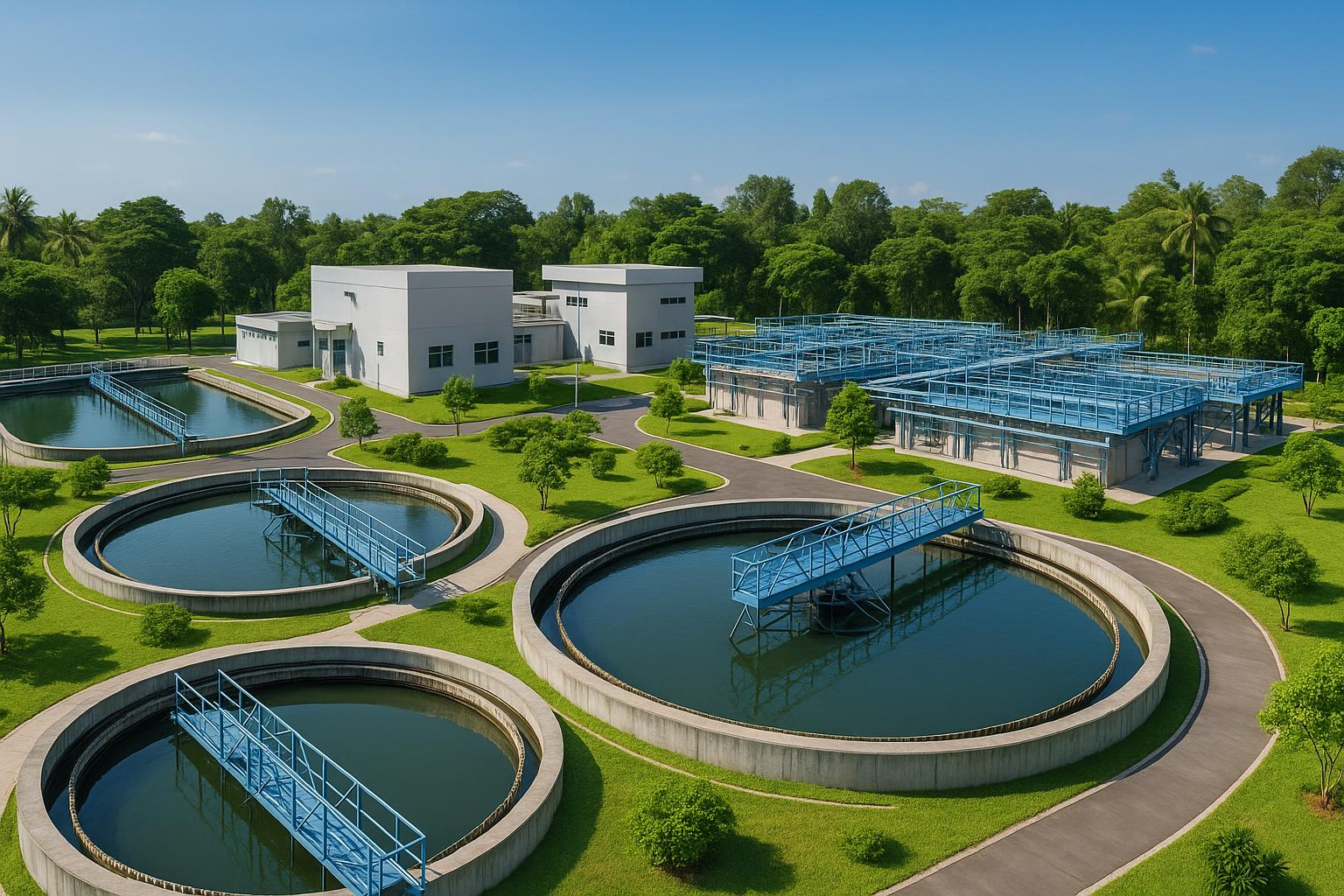
1. Context of renovating the dyeing wastewater treatment system and compliance pressure
In recent years, dyeing industrial zones have rapidly expanded in scale, meaning that the volume of wastewater has increasingly risen both in flow and complexity. According to records from a technology cooperation program on dyeing wastewater treatment, the Vietnamese textile industry generates about 24 – 30 million m3 of wastewater each year, but only about 10% is treated before being discharged into the environment. This reflects two realities: many factories lack a systematic treatment system, or if they have one, it does not operate stably, especially when the characteristics of the incoming water fluctuate according to production batches, shifts, and products.
Regarding legal requirements, dyeing enterprises need to aim to meet the industry standards for dyeing wastewater, specifically QCVN 13-MT:2015/BTNMT. This standard serves as the basis for designing, renovating, and operating the treatment system, as well as for compliance monitoring. Although the limit values are not reiterated here, the technological orientation and measurement points, indicators such as COD, BOD5, color, total N, total P, heavy metals, coliforms… are all central when assessing the system's effectiveness. In the context of increasingly high “green” export requirements, meeting discharge standards is not only a legal condition but also a requirement from the supply chain.
The financial aspect is always a top concern when renovating. Actual data in the industry shows that the operating costs for dyeing wastewater treatment (OPEX) typically range from 9,000 to 25,000 VND/m3 depending on the output requirements; with stricter outputs usually around 9,000 – 15,000 VND/m3, while lower requirements can be around 3,000 – 6,000 VND/m3. This serves as a reference for investors to estimate total monthly expenditures, while also reflecting on cost components (chemicals, electricity, sludge, labor) when choosing technology options. It should be noted that enhanced biological solutions using microbial products have been reported not to significantly increase operating costs, while potentially improving the stability of color and organic treatment.
This article focuses on advanced biological strategies for upgrading, accompanied by cost-effectiveness analysis based on actual data, while also identifying common operational bottlenecks. The goal is to help dyeing enterprises plan renovations that are appropriate to the current situation and output standards, optimize total lifecycle costs, and enhance the reliability of the system.

2. Characteristics of dyeing wastewater and operational consequences
Dyeing wastewater is continuously generated from processes such as sizing, washing, cooking – bleaching, dyeing, printing, and finishing; with a large volume coming from the washing processes after treatment. Water consumption is significant and varies by product: estimated at 120 – 300 m3/ton of fabric; at the product unit level, 1 meter of fabric may require 12 – 65 liters of water and discharge 10 – 40 liters. The complexity increases when products switch between cotton, polyester, and blended fibers; thus, the composition of wastewater changes and complicates the optimization of operational parameters in a “one-size-fits-all” approach.
The main pollutants include dyes, detergents, surfactants, oils, heavy metals (such as Cr, Cu, Zn, Pb, Ni), and salts. A noteworthy point is that the COD/BOD ratio is often high due to the presence of non-biodegradable organic matter: in some cases, wastewater from the use of reactive dyes for floral printing has a BOD close to zero, while COD is around 900 mg/L. This signals the role of chemical-physical pretreatment to “break down” color and stable components, to reduce the load on the biological segment downstream. Additionally, high conductivity and total dissolved solids (TDS) due to the use of many salts (Na2SO4, NaCl) also pose significant challenges if enterprises consider water reuse.
The differentiation between internal discharge streams is significant. For example, sulfide wastewater and wastewater from bleaching processes often have much higher COD and BOD5 loads, strong alkaline pH, and dark colors. In contrast, domestic wastewater in the factory, while having lighter pollution levels, is still sufficient to disrupt operations if mixed without control. Identifying and separating streams, then designing pretreatment and balancing flow – concentration, is the premise of a stable operating system.
| Indicator | Unit | Domestic wastewater in the factory | Sulfide wastewater | Bleaching wastewater |
|---|---|---|---|---|
| pH | - | 10 – 11 | > 11 | > 12 |
| COD | mg/L | 450 – 1.500 | 10.000 – 40.000 | 9.000 – 30.000 |
| BOD5 | mg/L | 200 – 800 | 2.000 – 10.000 | 4.000 – 30.000 |
| Total N | mg/L | 5 – 15 | 100 – 1.000 | 200 – 1.000 |
| Total P | mg/L | 0.7 – 3 | 7 – 30 | 10 – 30 |
| Color | Pt-Co | 7.000 – 50.000 | 10.000 – 50.000 | 500 – 2.000 |
| Turbidity | FAU | 140 – 1.500 | 8.000 – 200.000 | 1.000 – 5.000 |
With the prevalence of such loads, a treatment system relying solely on traditional biology risks color overload, large fluctuations in pH, and organic shock loads. Once activated sludge is damaged, the consequences spread to poor settling, scum, filamentous sludge, and a significant increase in the consumption of coagulant chemicals. Therefore, the optimal technology strategy is often a dual configuration: controlled chemical-physical pretreatment, followed by upgrading the biological segment to increase the density and diversity of microbial populations, helping to cope with non-biodegradable organics and maintain long-term stability.
3. Core technology components in renovation: from pretreatment to biology
3.1. Flow regulation, stream separation, and input protection
The starting point of any renovation project is to establish flow – concentration regulation and strategic stream separation. The collection pit and regulation tank need to operate as a “dynamic buffer,” especially when the factory runs in batches or experiences hourly fluctuations. The arrangement of coarse screens and fine mesh filters helps protect downstream equipment; fine mesh with a size of about 1 mm effectively removes fibers and particulate materials, reducing the load of suspended solids entering the reaction tank. In the regulation tank, mixing and light aeration help homogenize, limit sedimentation, and form odors.
Stream separation by characteristics is a way to control risks from the outset. Branches with very high alkaline pH, containing sulfides or concentrated salts should be collected separately for controlled neutralization and dilution before mixing. This way, neutralizing chemicals are used at the right time, in the right stream, saving compared to a “mass neutralization” scenario for the entire flow. At the same time, it avoids pH shocks to the biological tank, which is a common cause of filamentous sludge blooming and reduced settling performance.
3.2. “Just-in-time” chemical-physical pretreatment
The goal of this stage is to reduce color, along with some COD/BOD, and break down non-biodegradable components. Due to the specific characteristics of raw materials and technology chains, the “direction” should be flexible: for polyester or blended fibers, many facilities apply coagulation – flocculation before entering biological treatment; while for cotton, there is a model of implementing biological treatment first, then chemical-physical, followed by tertiary treatment for refinement. This difference arises from the degree of color adherence, sizing agents, and technological aids used in each processing stage.
In the reaction tank, pH-adjusting chemicals and coagulants are evenly distributed thanks to rapid mixing; followed by a flocculation tank with slow mixing and possibly adding anionic polymer coagulants to develop flocs of sufficient size, weight, and easy settling. The chemical-physical settling phase then separates sludge – water, thereby reducing color and SS loads for the biological segment. Practical experience shows that the installation of “just the right dose – at the right point” of chemicals in the pretreatment stage is a decisive factor for monthly OPEX bills, as well as for the input stability of the biological tank.
3.3. Traditional aerobic biology and improvement windows
The aeration tank remains the “heart” of biological treatment in most dyeing factories. Air is evenly supplied to maintain an aerobic environment, where microorganisms consume the remaining dissolved organic matter and form activated sludge. To develop activated sludge into a stable population, practical operations often maintain sludge concentrations of about 2,500 – 4,000 mg/L, combined with returning sludge from the settling tank to the aeration tank to maintain the required biomass level. When conditions are suitable, the aerobic tank can achieve BOD and COD removal efficiencies of 90 – 95%.
However, color compounds and metal complexes can pass through traditional biology if there is no appropriate pretreatment, or when microorganisms lack diversity to decompose specific components of dyeing. At this point, improvement options such as enhancing microbial diversity (bioaugmentation), adding adhesion substrates to increase biomass density, or reorganizing hydraulics to resist shock loads, will open up room to enhance performance without necessarily having to build new tanks. These improvements also help the second settling tank operate more “easily,” reducing the risk of sludge overflow and lowering polymer costs in the sludge-water separation stage.
4. Advanced biotechnology: bioaugmentation and multi-layer combinations
4.1. Adding selective microbial products (bioaugmentation)
Domestic studies have developed a mixture of microbial strains screened from various sources (soil, dye-contaminated water, activated sludge…), identified using molecular biology techniques, with the ability to decompose many groups of organic substances and especially to act on various dyes. When introduced into the operating system, this mixture helps expand the degradation spectrum, improve color removal quality, and enhance stability against input fluctuations. Notably, in experimental trials, the color removal rate of methyl red reached about 89.82% within 24 hours; in actual dyeing wastewater, the color removal level remains high and less variable, usually around 81.41 – 88.28% when supplemented with the product compared to when not supplemented.
In terms of implementation, a significant advantage is that the product can be directly introduced into the existing system without requiring structural changes. This allows enterprises to quickly pilot on the sludge return line or an intermediate tank before the aeration tank, monitoring the response of the microbial community and restoring if necessary. Records from actual operations show that operating costs increase insignificantly due to the nature of the microorganisms being nurtured and reused in the system, while enterprises benefit from a “smoother” post-treatment quality picture, reducing fluctuations and compliance risks.
4.2. Increasing density and “stability” of microbial populations
In addition to bioaugmentation, another improvement direction is to increase the biomass capacity within the same tank volume. In principle, by providing adhesion surfaces, microorganisms form biofilms and increase local density, helping to enhance shock load resistance, prevent washout, and improve settling due to the biomass being in the form of a film rather than entirely suspended. The tank configuration can be adjusted to create alternating “contact – reaction” zones, utilizing both adsorption – degradation mechanisms and gradually adapting to difficult-to-treat compounds.
In the highly variable dyeing environment, having an active adhered biomass “core” operating in parallel with suspended activated sludge is a stable operational support. This combination also opens up space to apply targeted bioaugmentation: supplementing specialized microbial groups to decompose specific components of dyes, sizing agents, or additives. Even without changing tank sizes, enterprises can achieve higher and more stable biological activity levels.
4.3. Multi-layer color removal: combining biological and chemical-physical/oxidation
Color removal is the “bottleneck” of many dyeing systems. An effective practical approach is multi-layer coordination: chemical-physical to aggregate color and heavy metals into flocs; biological to treat dissolved organic matter and remaining color; and, when necessary, using processes like UV or ozone to eliminate persistent colors and disinfect in tertiary treatment. With this configuration, heavy color loads are treated upfront, while the biological tank plays a primary role with organics, reducing the chemical burden and sludge disposal costs.
More importantly, once bioaugmentation is in place, the “biological” layer in the color removal stage becomes more proactive towards target compounds. Enterprises can monitor the Pt-Co color levels in the intermediate tank after chemical-physical treatment and after the biological tank to optimize chemical dosing and biological retention time, instead of trying to force all color into the chemical-physical layer with excessive polymer/H2O2, which can cause increased sludge and long-term OPEX increases.
5. Treatment effectiveness and data support points
In terms of organic indicators, a properly operated aerobic tank can achieve 90 – 95% removal of BOD and COD, providing a foundation for output to meet requirements. Meanwhile, enhancing with microbial products proves particularly effective in color indicators: for single dye samples like methyl red, color removal can reach nearly 90% in just 24 hours of testing; in actual mixed dyeing wastewater, the color removal range is recorded at over 81% to nearly 88% and fluctuates less than without supplementation.
Another technical “cornerstone” is managing activated sludge. Practical operational experience indicates that maintaining sludge concentrations around 2,500 – 4,000 mg/L helps balance adsorption – degradation and settling capabilities. When bioaugmentation is added, the microbial population becomes more diverse, helping to reduce filamentous sludge phenomena and increase the “compactness” of sludge flocs in the settling tank. The direct consequence is a reduced need for polymer coagulants and improved clarity before entering pressure filtration or tertiary treatment.
With “difficult” streams such as sulfide wastewater or from bleaching processes with COD levels in the tens of thousands mg/L, the strategy of controlled separation – dilution, neutralizing pH for each stream, and applying chemical-physical treatment before biological treatment is key. This way, the “difficult” part will be partially eliminated from the start, leaving the “easier” part for biology to achieve high efficiency, and the overall system rarely falls into a cycle of shock loading – performance drop – increased chemicals – sludge bulking.
6. Cost issues: investment, operation, and optimization roadmap
In terms of operation, the typical treatment cost for each cubic meter of dyeing wastewater ranges from 9,000 to 25,000 VND/m3, depending on output requirements and the level of optimization of the technology chain. With stricter discharge thresholds, costs are recorded at around 9,000 – 15,000 VND/m3; with lower requirements, they can range from 3,000 to 6,000 VND/m3. These figures help enterprises estimate monthly costs based on generated flow, while also serving as a “benchmark” to evaluate effectiveness when considering upgrading biological technology or optimizing chemical-physical pretreatment.
At the investment level, each factory has different tank structures and land funds, making it difficult to provide a standard figure. However, a practical experience is to prioritize solutions that utilize existing infrastructure: improving existing tanks, implanting enhanced microorganisms, arranging local substrates to increase biomass density, and fine-tuning hydraulics to avoid short-circuiting. This significantly reduces new construction costs, shortens renovation time, and minimizes production disruptions; at the same time, due to the nature of microorganisms being maintained and reused in the system, operating costs do not significantly increase when products are supplemented.
An industry reference example shows that with a system scale of 2,000 m3/day, choosing the right solution can save over 10 million VND per day, corresponding to over 3 billion VND per year. Of course, the actual figure will depend on the underlying technology path, currently used chemicals, target output levels, and operational discipline. Enterprises should establish an OPEX baseline by component (electricity, chemicals, sludge, labor), from which to set savings targets for each “sub-path” right from the renovation planning stage.
In terms of strategy, enterprises should consider quickly piloting (pilot) with microbial products on a return line or a semi-scale tank, to measure the “openness” regarding color and COD, from which to decide the level of investment in hardware (substrates, gas upgrades, tank compartmentalization…). The “biology first, hardware later” approach helps reduce financial risks and gather experimental data that accurately matches the factory's discharge streams.
7. Common operational errors and biological solutions
Firstly, organic and pH shock loading is a recurring issue in batch production factories. When additives and dyes change shifts, wastewater can spike in COD and alkalinity. The remedy is to increase the “buffer” capacity in the regulation tank, separately neutralizing strong alkaline branches in a controlled manner, and establishing bioaugmentation to enhance the ability to “consume” difficult-to-decompose compounds. Adding biology helps activated sludge recover faster after shock events, limiting the cycle of reduced settling – increased polymer.
Secondly, persistent colors are difficult to treat if relying solely on one technology layer. Overusing polymers or oxidizing agents to force color into sludge will significantly increase sludge disposal costs and may create stubborn by-products. Multi-layer combinations as mentioned (moderate chemical-physical, enhanced biology, and only using UV/ozone when necessary in tertiary treatment) help optimize total costs. Experimental data shows that when supplemented with microbial products, post-biological color levels decrease steadily and fluctuate less, providing a basis for reducing chemicals in pretreatment.
Thirdly, filamentous sludge and poor settling often stem from imbalances in microbial populations and unstable aerobic conditions. Maintaining activated sludge concentrations in the range of 2,500 – 4,000 mg/L, reasonable sludge recycling, and supplementing “correct” microbial groups help restore sludge floc structure. Additionally, compartmentalizing tanks to limit short-circuiting, regulating hydraulics, and limiting sudden mixing of saline/alkaline discharges into biology are also effective “fire-fighting” principles.
Finally, high chemical consumption due to “chasing” output is a common situation. Factories tend to increase coagulant – coagulant aid doses when post-settling water is poor, while the root cause lies in damaged biology. The biological approach – meaning restoring/renewing the microbial population, increasing adhesion area, and introducing loads in a gradual manner – will relieve pressure on chemical-physical treatment and lower overall costs to a more sustainable level.
8. Implementation roadmap for renovation: from survey to long-term optimization
Stage 1: Survey – sampling – establishing a baseline. Collect samples from typical branches (sulfide, bleaching, dyeing, domestic) and at key points in the system. Build a map of COD/BOD5, pH, color, N, P by shift/day; while also recording chemical, electricity, sludge consumption, and shock events in the last 1 – 2 months. This result is baseline data to evaluate “where” intervention is needed and “how much” is sufficient.
Stage 2: Biological pilot. Apply microbial products in a gradually increasing manner on the sludge return line or intermediate tank, alongside controlled pH and moderate chemical-physical treatment. Monitor Pt-Co color, COD, BOD5 before – after biological treatment, along with filamentous sludge/settling phenomena. The goal is to record the amplitude of color improvement (referencing the level of 81.41 – 88.28% observed in actual dyeing wastewater when supplemented), from which to decide the level of hardware investment needed.
Stage 3: Targeted hardware improvements. Based on pilot results, consider adding adhesion substrates, restructuring hydraulics to avoid short-circuiting, and upgrading aeration if necessary. Upstream, fine-tune chemical dosing/points, optimize coagulant aids, and standardize neutralization processes for high pH streams. This should be done in small steps, measuring impacts before moving on to the next step to avoid over-investment.
Stage 4: Optimal operation and cost standardization. Once the system is stable, conduct periodic optimization based on actual data: compare costs by component before – after renovation, adjust chemical-physical strategies according to seasonal and product fluctuations, and maintain the bioaugmentation program at optimal frequencies. The goal is to bring OPEX within the stated target range, while also maintaining a safety margin for compliance with QCVN 13-MT:2015/BTNMT.
9. Conclusion: biotechnology is the “lever” to enhance performance and reduce long-term costs
Renovating the dyeing wastewater treatment system is not simply about replacing tanks or increasing chemicals; it is a synchronized problem between “just enough” pretreatment, “smart” biology, and “worthy” tertiary treatment. Operational data shows that aerobic biology, if operated correctly, can handle 90 – 95% of the workload with BOD/COD. When enhanced with selected microbial products, the system can expand its color treatment spectrum – often the most “challenging” indicator – with impressive and more stable improvements compared to pure operation.
In terms of costs, industry experience records an OPEX range of 9,000 – 25,000 VND/m3 as feasible depending on output targets, and supplementing microbial products does not significantly increase these costs. In fact, choosing the right configuration and contractor can yield savings of tens of millions of VND per day for a 2,000 m3/day factory. What enterprises need is a data-driven roadmap, controlled piloting, and “right place – right time” hardware improvements.
Finally, in the context of increasingly stringent market and legal requirements, the orientation towards biotechnology – cleverly combined with chemical-physical pretreatment and tertiary treatment – is a sustainable path to both meet QCVN 13-MT:2015/BTNMT standards and optimize total lifecycle costs while reducing compliance risks. The figures and experiences mentioned in the article are a solid “support point” for investors to design renovation plans effectively and cautiously.
FAQ
1) Why is dyeing wastewater difficult to treat with pure biology?
Because the COD/BOD ratio is often high due to many difficult-to-biodegrade organic components, sometimes with BOD close to 0 while COD remains around 900 mg/L for some process streams. Additionally, persistent color and metal complexes reduce the adsorption – degradation effectiveness of activated sludge.
2) What level of color removal can be achieved when supplementing with microbial products?
In experiments with methyl red, color removal reached about 89.82% after 24 hours. In actual dyeing wastewater, the color removal range is recorded at about 81.41 – 88.28% and fluctuates less than without supplementation.
3) What are the typical operating costs for dyeing wastewater treatment?
Costs typically range from 9,000 to 25,000 VND/m3 depending on output targets and technology optimization levels. With stricter requirements, it can be around 9,000 – 15,000 VND/m3, while lower levels range from 3,000 to 6,000 VND/m3.
4) How should the aerobic tank be operated to remain stable?
Practical operations indicate that maintaining activated sludge concentrations around 2,500 – 4,000 mg/L and reasonable sludge recycling helps maintain biomass. When conditions are suitable, the aerobic tank can achieve 90 – 95% removal of BOD/COD.
5) Is the generated wastewater flow large and does it fluctuate by product?
Water consumption is estimated at 120 – 300 m3/ton of fabric; at the level of one meter of fabric, it is 12 – 65 liters of water used and discharges 10 – 40 liters. This figure fluctuates according to fiber type, technology, and finishing requirements, causing input loads to change by shift.
6) Why is it necessary to separate streams and regulate before treatment?
Because streams such as sulfide and bleaching have very high pH and large COD/BOD, if mixed directly, they will shock the biological treatment and increase chemical costs. Stream separation helps neutralize at the right place, reduce fluctuations, and create conditions for biology to perform effectively and stably.
Nanoen
NANO THANG LONG ENVIRONMENTAL COMPANY LIMITED
Hanoi Office: No. 15 TT18 Van Phu Urban Area, Ha Dong, Hanoi
Can Tho Office: 661E/29, Vo Van Kiet Street, Binh Yen A Area, Long Hoa Ward, Binh Thuy District, Can Tho City
Ho Chi Minh City Office: 533/12/7, Pham Van Bach Street, Ward 15, Tan Binh District, Ho Chi Minh City
Hotline: 0986.689.781 - 0969.054.226
Email: thanglongnanoen@gmail.com
Facebook: www.facebook.com/thanglongnanoen