1. Current Context and Legal Requirements
The paint production industry generates a stream of wastewater that is difficult to treat due to the presence of a combination of non-biodegradable organic substances, additives, solvents, pigments, and surfactants. The effluent typically arises mainly from equipment cleaning after each production batch and cooling water during the grinding process, which are stages with fluctuating pollution loads depending on the shift and batch. As a result, the wastewater treatment systems of many facilities face sudden fluctuations in COD, SS, color, and toxicity, exceeding the "shock resistance" of traditional biological treatment lines without a robust chemical-physical pre-treatment layer.
From a compliance perspective, the goal of the renovation project is to achieve stable outputs according to the discharge standards applicable to industrial wastewater. In this article, we consider the legal objective to meet QCVN 40:2025/BTNMT (industrial wastewater). This entails the requirement for the technology combination to both "reduce the load" of non-biodegradable organic matter and suspended solids before biological treatment, while ensuring that the characteristic indicators (color, odor, biodegradability) are sufficiently "friendly" to microorganisms. Therefore, the renovation design should approach the philosophy that chemical-physical pre-treatment plays the primary role in removing difficult components, while biological treatment serves as the final "polishing" layer to stabilize the dissolved organic index.
In the context of increasing operational pressure (seasonal load fluctuations, cost reduction requirements) and increasingly stringent legal expectations, a sound renovation strategy should prioritize three pillars: stabilizing inputs (regulation - shock resistance), controlled advanced oxidation (Fenton is a typical choice for paint effluent), and optimizing aerobic biological treatment after chemical-physical processes. The technological solutions presented below stem from the actual data of paint effluent and focus on control points that investors can act on immediately during the renovation phase.
2. Characteristics of Paint Production Wastewater and Renovation Implications
Actual data from paint wastewater shows an imbalance between total organic content (COD) and biodegradable organic content (BOD5). For example, a technical data source in the industry recorded that the incoming wastewater has a pH of about 8.5; BOD5 of about 588 mg/L; COD reaching up to 5621 mg/L; and suspended solids (SS) of about 2109 mg/L. The low BOD5/COD ratio reflects that most of the organic matter consists of stable compounds that are difficult for microorganisms to treat directly. The high SS content originates from pigments, additives, paint residues, and dispersed colloidal particles – these particles need to be "coagulated" through a coagulation mechanism to form flocs before settling.
The main sources of generation include equipment cleaning water and cooling water. The equipment cleaning water often "carries" pigments, film-forming resins, solvents, and even trace metals from pigments, causing sudden load fluctuations with each cleaning batch. Cooling water during the grinding process may carry some additives and solvents, contributing to increased COD and color. This cyclical nature explains why many existing systems (which only have coagulation - settling and simple biological treatment) often encounter thick foam, floating sludge, and fluctuations in output COD after each equipment washing cycle.
The implication for renovation is that a sufficiently strong "chemical-physical" front must be established before biological treatment, with three tasks: reducing SS/color through coagulation - flocculation, oxidizing the non-biodegradable organic portion using Fenton at acidic pH, and neutralizing to bring pH to a level favorable for microorganisms. Along with this, an aerated equalization tank will serve as a "buffer" for flow and concentration, reducing load fluctuations throughout the day. These changes often create breakthroughs for the Aerotank system downstream: reduced toxicity for microorganisms, less shock loading, decreased foam and floating sludge, thereby stabilizing outputs according to the requirements of QCVN 40:2025/BTNMT.
3. Specific Treatment Technologies When Renovating the System
3.1. Reference Technology Diagram and Control Points
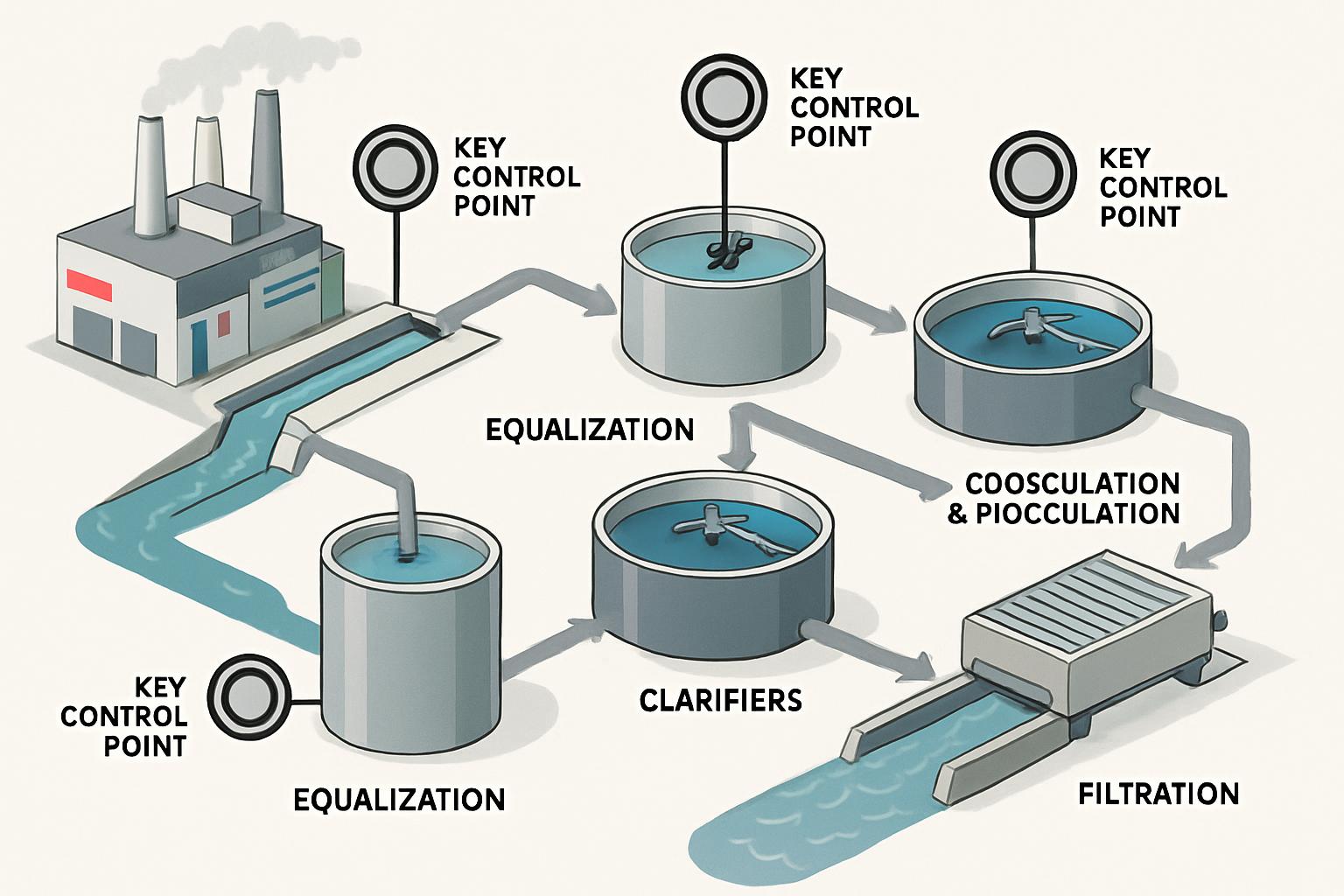
A suitable treatment line for paint wastewater after renovation typically follows the sequence: bar screen – collection pit – aerated equalization tank – coagulation/flocculation – settling I – Fenton oxidation (acidic pH) – neutralization (slightly alkaline pH) – aerobic biological tank (Aerotank) – settling II – disinfection – discharge to the receiving source. At each technology node, control requirements must be "identified" to prevent process errors: flow/DO in equalization; stirring speed and coagulant/polymer dosage in coagulation; pH and chemical dosing sequence in Fenton; and pH/alkalinity after neutralization for stable microbial activity.
The equalization phase is the "heart" of shock reduction. Aeration not only prevents sludge settling but also limits anaerobic odor generation during retention time. The coagulation - flocculation layer that follows aims to break down colloids, binding fine particles into larger flocs for preliminary settling; selecting PAC, aluminum sulfate, iron sulfate, and anionic/cationic polymers depending on the water properties after jar tests. After settling I, the clear water enters Fenton for deep oxidation of difficult-to-degrade COD.
In the Fenton stage, the pH is lowered to the acidic range before adding H2O2 and iron salts to generate hydroxyl radicals, breaking down stable organic chains. After Fenton, the neutralization tank raises the pH to neutral/slightly alkaline before transitioning to Aerotank. The aerobic biological tank will absorb the remaining organic matter, converting it into CO2, H2O, and biomass; a portion of the settled sludge is recirculated back to the Aerotank to maintain microbial density. Filtration/disinfection at the final step completes the clarity and biological safety before discharge.
3.2. Fenton Oxidation in Paint Wastewater: Design and Operation During Renovation
For paint wastewater, Fenton is a "lever" technology because it can remove a significant portion of difficult-to-degrade COD. According to technical data in the industry, effective operation requires maintaining an acidic pH of about 3–4 in the reaction tank; at this pH, hydrogen peroxide reacts with iron (II) to generate highly oxidative hydroxyl radicals. In terms of effectiveness, operational documentation records that Fenton can achieve about 80% COD removal depending on water properties and optimal dosage.
During the renovation phase, it is necessary to arrange a separate acid/chemical dosing station that operates in sequence: adjusting pH down to the target range, adding iron salt catalyst, and then adding H2O2 according to a segmented dosing strategy to limit excess. Some lines also supplement oxidizing agents like KMnO4 depending on the case. Mixing in the Fenton tank must be sufficient to evenly disperse the chemicals but not cause fragmentation of the flocs formed later; therefore, the tank is usually divided into two zones: fast reaction and slow reaction, before transitioning to neutral settling.
Two typical risks need to be "locked" by design and SOP: excess H2O2 carried into biological treatment causing inhibition of microorganisms, and excessive iron hydroxide sludge generation causing blockage/difficulty in water separation. Control measures include: balancing between H2O2 and Fe(II) dosage, continuous pH monitoring, and ensuring neutralization/coagulation after Fenton is given enough time to precipitate iron into easily settling sludge. The amount of Fenton sludge needs a collection and dewatering plan periodically, avoiding accumulation in sludge storage tanks that disrupt the main flow.
3.3. Coagulation - Flocculation and Primary Settling: Optimizing to Reduce SS and Color
Coagulation - flocculation is an important "gateway" because paint wastewater has high SS and color; poor reduction will push the burden downstream to Fenton and biological treatment. The choice of aluminum sulfate, PAC, or iron sulfate depends on color and colloidal particle composition; coagulant aids help form large, dense flocs for quick settling. Jar-test experiments are an indispensable tool in the renovation phase to determine the type of chemicals, dosing order, and initial dosage before fine-tuning in practice.
Stable operation requires controlling stirring speed in two phases: fast stirring to disperse coagulants, and slow stirring to nurture flocs. Insufficient coagulant dosage leads to cloudy water and high color; excessive dosage can cause re-stabilization of particles and increased sludge load. Excess polymer leaves a viscous residue, causing floating sludge in settling I and blocking sludge pipes. The cleaning cycle for settling tanks, sludge collection systems, and weir channels must also be standardized to avoid sludge leakage into subsequent processes.
After Fenton, neutralization and adding alkalinity to a level favorable for microorganisms is mandatory to prevent the Aerotank from experiencing acid "shock". In many systems, anionic polymer is used after Fenton to "gather" iron hydroxide flocs and oxidized organic residues, helping neutral settling achieve high efficiency. This creates a solid buffer layer for the Aerotank to receive clear water, reducing foam and floating sludge during the initial restart phase after renovation.
3.4. Aerobic Biological Treatment (Aerotank) After Chemical-Physical Processes
The Aerotank plays a role in completing the remaining dissolved organic matter after chemical-physical processes have removed the difficult-to-degrade fractions. When the input has passed through Fenton and neutralization, aerobic microorganisms have a less toxic environment to convert organic matter into CO2, H2O, and biomass. A portion of the settled sludge is recirculated back to the Aerotank to maintain appropriate biomass density; excess sludge is collected to a sludge storage tank for periodic treatment. Settling II needs to operate gently, avoiding disturbances that cause fine sludge to be carried out.
With paint wastewater, foam is a common phenomenon due to surfactants. Moderate foam is normal, but continuous thick foam accompanied by reduced settling quality may signal organic overload, toxic shock, or insufficient equalization to dampen batch fluctuations. A sustainable solution is to return to optimizing pre-treatment (coagulation/Fenton) and equalization, using defoamers only as a short-term support measure. The disinfection step at the end of the line helps reduce the risk of pathogenic microorganisms before discharge.
In renovation projects, existing Aerotanks are often retained, and the "key" is to make their input "comfortable". When the COD load entering the Aerotank decreases and stabilizes due to Fenton, the demand for aeration and the risk of floating sludge also decrease. This brings dual benefits: saving aeration energy and expanding the operational safety margin on days of increased load due to equipment washing.
4. Reference Table of Actual Parameters and pH Setting Points According to Technology
The table below summarizes actual data and typical setting points derived from the practice of treating paint wastewater, serving to shape renovation and operational criteria.
| Item | Data/Setting Point | Process/Related | Notes |
|---|---|---|---|
| Input wastewater pH | 8.5 | System input | Actual data from paint wastewater |
| Input BOD5 | 588 mg/L | System input | Reflects low biodegradable organic ratio |
| Input COD | 5621 mg/L | System input | Very high total organic content |
| Input SS (TSS) | 2109 mg/L | System input | Need to reduce load through coagulation - settling |
| Fenton tank pH | 3–4 | Advanced oxidation (Fenton) | Lower acidic pH before adding H2O2 and iron salts |
| Fenton COD removal efficiency | Up to 80% | Advanced oxidation (Fenton) | Depends on optimal dosage and water properties |
| pH after neutralization | > 7 | Before aerobic biological treatment | Create favorable conditions for microorganisms |
5. Renovation Costs: Components, Scenarios, and Optimizing OPEX/CAPEX
The costs of renovating paint wastewater treatment systems typically come from four groups: (i) construction, renovation of tanks (adding equalization, Fenton, neutral settling); (ii) equipment – electromechanical (H2O2/acid/alkali chemical dosing units, mixers, dosing pumps, aeration systems, settling and sludge collection plates); (iii) operational chemicals (coagulants, polymers, H2O2, iron salts, acids, alkalis); and (iv) sludge management (dewatering, storage, treatment outsourcing). Among these, the chemical and sludge components are variable costs that determine OPEX; the construction and equipment parts are CAPEX depending on the level of renovation. The choice of technology and the level of "depth" of renovation should be based on a life-cycle cash flow analysis, as higher CAPEX options (e.g., systematic Fenton, larger equalization) often lead to lower OPEX and reduced sustainable compliance risks.
Three common renovation scenarios are: (1) adding a complete chemical-physical package (coagulation - settling + Fenton + neutralization) before Aerotank when the existing system only has biological treatment; (2) enhancing Fenton and neutralization when coagulation - settling is already in place but outputs still fluctuate due to difficult-to-degrade organic matter; and (3) fine-tuning chemicals, adding dosing stations, and optimizing equalization if the basic tank infrastructure is already available. Each scenario carries different cost components, but the common denominator is to "hit" the bottleneck: reducing difficult-to-degrade COD and SS before entering biological treatment.
The cost optimization strategy includes: using equalization to flatten peak loads (reducing peak chemical dosages); conducting jar-test experiments and/or pilot Fenton tests to find the optimal pH/chemical dosage range before expanding to the entire system; reconfiguring existing tanks (e.g., partitioning old tanks into Fenton - neutralization reaction zones) to reduce new construction costs; and standardizing the sludge dewatering process to reduce transportation/treatment costs for wet sludge. In operation, good control of pH in Fenton and neutralization helps avoid excess H2O2/alkali, thus saving both chemicals and preventing the risk of microbial inhibition that incurs high remediation costs.
6. Common Operational Errors When Applying Technology to Paint Wastewater
The "core" error is poor pH control in Fenton. If the pH is higher than the target acidic range, the generated hydroxyl radicals are insufficient to break down organic chains, leading to low efficiency while chemical costs remain high. Conversely, lowering the pH too deeply and then failing to neutralize leads to residual acid/alkali and iron salts entering biological treatment, easily causing microbial shock and generating fine sludge that is difficult to settle. The remedy is to install online pH measurement in both the Fenton and neutralization tanks, interlocking dosing pumps with safety limits, and training operators on the chemical dosing sequence.
Coagulation - flocculation often encounters "guessing dosages" without regular jar-tests. This can easily lead to insufficient coagulant when loads increase (cloudy water, high color) or excessive coagulant/polymer (re-stabilizing particles, floating sludge, viscous film blockage). The standard procedure is to maintain sample testing weekly to update optimal dosages according to wastewater fluctuations, while also recording changes in the type of paint/additives being produced to forecast timely chemical adjustments.
In the Aerotank, thick foam and floating sludge are often associated with strong input fluctuations after each equipment wash. Attempting to "suppress" with defoamers without adjusting pre-treatment only addresses the symptoms, not the root causes. Investing time to optimize equalization, enhance coagulation and Fenton efficiency will significantly reduce foam; simultaneously, ensuring reasonable sludge recirculation and cleaning the water collection pipes/weir channels to avoid carrying sludge with clear water.
Neglecting sludge management is a costly silent error. Sludge from settling I and post-Fenton settling, if not collected – dewatered smoothly, will overflow, causing odors and increasing SS in subsequent tanks. Planning for dredging, dewatering, and storage according to actual loads, along with a sludge log (volume, moisture, destination) is essential to avoid operational disruptions and unexpected costs due to emergency treatment outsourcing.
7. Roadmap for Renovating Existing Systems: From Survey to Trial Run
The starting step is to survey the current situation and collect characteristic data by batch, especially during/after equipment cleaning shifts. Sampling for COD, BOD5, SS, pH, and observing color and odor at various times to see the fluctuation range. From this data, conduct jar-tests for coagulation - flocculation to select the type of coagulant/polymer, and small-scale Fenton experiments to determine the reaction pH range, chemical dosing sequence, and the ability to reduce difficult-to-degrade COD. These initial experiments lay the foundation for calculating tank sizes and selecting appropriate dosing/mixing equipment.
Once the "technology project" is established, the renovation design phase should prioritize utilizing existing tanks by partitioning – changing functionality (e.g., converting an empty tank into a Fenton - neutralization tank), thereby reducing new construction costs. Install a chemical dosing system with spill-proof storage tanks, dosing pumps with one-way valves/safety cut-off, and online pH measurement. The aeration system in equalization and Aerotank needs to be checked for flow – pressure to ensure it meets increased loads. Settling I should be equipped with sufficient sludge collection pipes/weir channels to prevent sludge overflow when flow suddenly increases.
The trial run consists of two phases: no load (checking for water tightness, equipment, interlocks) and with load (gradually increasing flow, monitoring indicators in each tank). In Fenton, monitor pH and color/COD reduction at each control point; in neutralization, ensure that the pH after adjustment is greater than 7 before entering the Aerotank. In biological treatment, observe foam, odor, settling ability, and adjust sludge recirculation. Establishing operational - incident SOPs, training shifts, and building periodic chemical/sludge plans are key to bringing the system into a stable "track".
8. Outline of Typical Scenarios in Renovation (Anonymous)
One facility has existing coagulation - settling and Aerotank but frequently exceeds COD after each equipment wash. The renovation solution focuses on adding a Fenton tank with acidic operating pH and a neutralization tank before biological treatment. After optimizing jar-tests and Fenton experiments, the system operates with a standardized chemical dosing sequence and neutralizes to slightly alkaline pH. The result is reduced foam in the Aerotank, better settling sludge, and stable output COD according to applicable standards.
Another facility, which only has aerobic biological treatment, experiences floating sludge and thick foam due to cooling water and equipment cleaning causing hourly load surges. The renovation plan includes building an aerated equalization tank, upgrading coagulation - flocculation and primary settling before biological treatment. The "flattening" of loads through equalization, combined with reducing SS/color through coagulation, makes the Aerotank less shocked; when enhancement is needed, Fenton is added as an advanced oxidation layer to treat remaining difficult-to-degrade organic matter.
These scenarios show a common point: the success of renovation does not necessarily lie in increasing biological size, but in effectively "clearing the path" for biology through reasonable chemical-physical treatment and effective equalization. When difficult-to-degrade organic matter and SS are properly removed, the remaining load becomes "easier" for microorganisms, thus creating stable outputs with a wider operational safety margin.
9. Investment Orientation: Technology and Compliance
In the renovation of paint wastewater treatment systems, investors should start from the actual data of their own plants, rather than copying the technology diagrams of others. Data such as input pH around 8.5; BOD5 approximately several hundred mg/L; COD reaching thousands of mg/L; SS at thousands of mg/L indicate the mandatory need for a "hard" chemical-physical layer (coagulation - settling, Fenton, and neutralization) before biological treatment. This approach not only increases the probability of meeting QCVN 40:2025/BTNMT but also opens up opportunities to optimize long-term operational costs.
Technology priorities are: (i) smart equalization to reduce shock, (ii) Fenton at pH 3–4 to break down stable organic matter with efficiency potentially reaching about 80% COD under optimal conditions, and (iii) aerobic biological treatment as the final "polishing" step. At the risk management level, investing in online monitoring (pH, flow) and standardizing operational - chemical - sludge SOPs is an important barrier to prevent operational "surprises" from turning into discharge incidents. When considering CAPEX/OPEX, it is advisable to evaluate based on the life cycle of the system and the costs of non-compliance to choose a reasonable renovation level, avoiding "saving first, paying later".
10. Frequently Asked Questions (FAQ)
1) Why must paint wastewater have a Fenton treatment layer before biological treatment?
Paint wastewater has a high ratio of difficult-to-degrade organic matter, reflected in high COD compared to BOD5. Operating Fenton at an acidic pH of around 3–4 helps generate hydroxyl radicals to break down stable organic chains, reducing toxicity before entering biological treatment.
2) How much can Fenton reduce COD?
Operational documentation records that COD removal efficiency can reach about 80% when optimizing pH and chemical dosage. Specific results depend on the composition of the wastewater and the load reduction achieved beforehand through coagulation - settling.
3) What pH setting is suitable for the main processes?
The input pH of paint wastewater is usually in the alkaline range, for example, around 8.5. Fenton needs to lower the pH to about 3–4, then neutralize to bring the pH above 7 before entering biological treatment to ensure stable microbial activity.
4) What characteristic input parameters should be noted when designing renovations?
Typical data includes BOD5 around 588 mg/L, COD approximately 5621 mg/L, and SS around 2109 mg/L. These figures emphasize the need to reduce SS/color through coagulation - settling and to cut down stable organic matter through Fenton before biological treatment.
5) How to reduce thick foam in the Aerotank with paint wastewater?
A sustainable solution is to stabilize inputs through equalization and increase the efficiency of load reduction in coagulation - Fenton to reduce surfactants entering biological treatment. Defoamers should only be used as a short-term support measure, while monitoring and adjusting sludge recirculation and cleaning weir channels to avoid carrying sludge.
6) After renovation, what regulations must the system comply with when discharging?
The compliance objective is to meet the requirements of QCVN 40:2025/BTNMT for industrial wastewater. The verification roadmap includes trial runs, sampling for comparison, and maintaining operations - keeping records ready for periodic environmental monitoring.
Nanoen
NANO THANG LONG ENVIRONMENTAL COMPANY LIMITED
Hanoi Office: No. 15 TT18 Van Phu Urban Area, Ha Dong, Hanoi
Can Tho Office: 661E/29, Vo Van Kiet Street, Binh Yen A Area, Long Hoa Ward, Binh Thuy District, Can Tho City
Ho Chi Minh City Office: 533/12/7, Pham Van Bach Street, Ward 15, Tan Binh District, Ho Chi Minh City
Hotline: 0986.689.781 - 0969.054.226
Email: thanglongnanoen@gmail.com
Facebook: www.facebook.com/thanglongnanoen