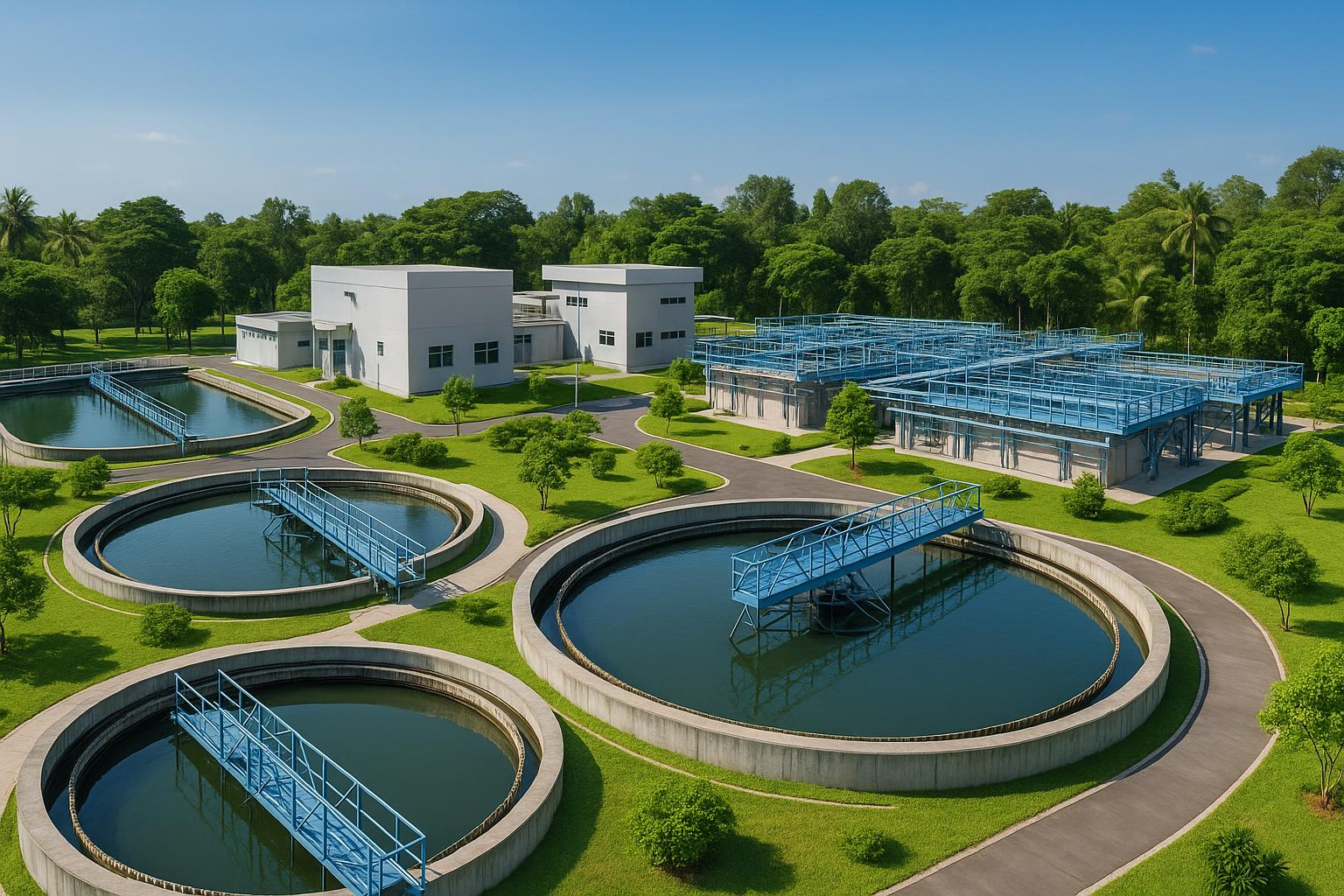
1. Context, Legal Requirements, and Approach by Capacity
Wastewater from the food processing industry has high organic and nutrient loads, fluctuating according to production shifts and cleaning activities. In this context, the choice of treatment technology always needs to adhere to two main axes: capacity scale (to optimize investment and land use) and wastewater characteristics (to select appropriate biological-chemical configurations). In Vietnam, industrial wastewater when discharged must meet current national technical regulations; for food production and processing facilities, businesses can refer to output requirements according to QCVN 40:2025/BTNMT. When consulting, the output parameters need to target this standard, and the technical solutions must demonstrate operational safety margins before load fluctuations occur.
This article proposes a technology selection framework based on capacity levels referenced in the literature: a small integrated scale group (about 5–40 m3/day), a workshop group of about 100 m3/day (typical processes include coagulation – biological – pressure filtration), and a larger capacity group (exceeding the thresholds of the above examples). For each group, we analyze the technology configuration, investment costs with reference data, core operational indicators, and common risks to help investors make the right decisions from the basic design stage.

2. Characteristics of Food Processing Wastewater Affecting Technology Selection
According to specialized reference documents, wastewater from food processing mainly arises from washing raw materials, preliminary processing, processing, and cleaning the production line. The common characteristic is a high organic load (starch, sugar, protein, fat), many suspended solids, oils and fats, containing nutrients such as nitrogen and phosphorus, while microorganisms from raw materials are also present. The variability in flow and concentration depends on production shifts and the timing of equipment cleaning; therefore, the regulation and pre-treatment stages are always an important "defensive line" to avoid shock loads for the biological process.
Typical data shows that input parameters are often at high levels: BOD5 around 700–2000 mg/L, COD around 1000–3500 mg/L, TSS around 350–700 mg/L. Total nitrogen is usually 100–350 mg/L, total phosphorus 30–100 mg/L, oils and fats 50–200 mg/L, total Coliform at levels of 10^4–10^5 MPN/100 mL. pH typically ranges around 6.5–8.5. These value ranges guide the arrangement of screenings – fat separation – coagulation/flotation (when oils/fats/sludge are high), selecting biological configurations with anaerobic or anoxic steps to remove nutrients, and considering membrane filtration or pressure filtration for reuse or enhancing water quality after treatment.
| Parameter | Unit | Typical Input Range (according to documents) |
|---|---|---|
| pH | - | 6.5 – 8.5 |
| BOD5 | mg/L | 700 – 2000 |
| COD | mg/L | 1000 – 3500 |
| TSS | mg/L | 350 – 700 |
| Total Nitrogen | mg/L | 100 – 350 |
| Total Phosphorus | mg/L | 30 – 100 |
| Oils and Fats | mg/L | 50 – 200 |
| Total Coliform | MPN/100 mL | 10^4 – 10^5 |
With high oil and fat characteristics, the fat separation and/or DAF flotation process plays a decisive role before the wastewater enters biological treatment. In dissolved air flotation, air is dissolved under pressure and released to create microbubbles smaller than 100 µm, which adhere to suspended particles, helping them float and be removed. When BOD/COD is high along with nitrogen, the anaerobic – anoxic – aerobic or membrane bioreactor (MBR) configuration helps decompose organics while also nitrifying – denitrifying. The oxygen demand for the nitrification process is also a notable energy parameter: documents state about 4.3 mg O2 for each mg NH4+, and the value of 4.57 mg O2/mg NH4+ is commonly used in design calculations.
3. Technology Selection by Capacity and Discharge Goals
3.1. Integrated Small Scale: about 5–40 m3/day with Packaged MBR
At a small scale, the combined aerobic biological tank solution with modular MBR is a reasonable choice due to its small footprint, minimizing the sedimentation – filtration – disinfection stages after biological treatment. According to referenced technical information, the packaged MBR system for the 5–40 m3/day range operates in a sequence: screening – fat separation – collection tank – regulation – anaerobic/aerobic – membrane module; at the regulation tank, air is supplied to avoid anaerobic conditions that cause odors, while the aerobic tank continuously supplies oxygen 24/7 to maintain microbial reactions. The membrane retains sludge and microorganisms, allowing clear water to pass through, thus eliminating the need for biological sedimentation tanks and filtration equipment typically seen in traditional technology.
The outstanding advantage of MBR is stable water quality, reducing the risk of sludge washout when flow fluctuates, and easy scalability by module. Investment costs have reference data for the 5–40 m3/day range (see the price table below), suitable for small production facility models or central kitchens. The downside is the need for membrane management (to prevent clogging, regular cleaning), controlling oils and fine solids before the membrane. With wastewater containing high nitrogen, it is essential to ensure an appropriate anaerobic/anoxic phase beforehand to support nutrient removal while balancing oxygen supply in the aerobic zone to meet both BOD/COD oxidation and nitrification (refer to the oxygen demand for NH4+ mentioned above).
| Nominal Capacity (m3/day) | Reference Price (VND) | Notes |
|---|---|---|
| 5 | 227,200,000 | Integrated MBR system, includes equipment and installation |
| 10 | 261,700,000 | Module – tank – operational equipment assembly |
| 15 | 313,900,000 | Including transportation, installation, and maintenance costs |
| 20 | 345,400,000 | Similar configuration, adjusted according to flow rate |
| 25 | 484,200,000 | Integrated MBR module and auxiliaries |
| 30 | 532,200,000 | Including operational training as a package |
| 35 | 554,200,000 | Total package reference price |
| 40 | 608,200,000 | Published price for the MBR system |
With the discharge goal of meeting QCVN 40:2025/BTNMT, the packaged MBR system helps streamline the treatment chain but still requires reasonable pre-treatment. Fat separation is mandatory for industries with high oil and fat content (fried foods, meat processing, seafood), and when TSS is high, compact coagulation/flotation can be added upfront to reduce the load on the membrane. In detailed design, it is necessary to control the filtration rate through pressure differential and maintain the chemical cleaning cycle according to the membrane manufacturer's recommendations to stabilize throughput.
3.2. Workshop Scale of about 100 m3/day: Chemical Combined with Biological – Pressure Filtration
With a capacity of approximately 100 m3/day, a combined chemical and biological process has been practically applied and described in the literature: collection – regulation – coagulation – flocculation – primary sedimentation – anoxic – aerobic (Aerotank) – secondary sedimentation – disinfection – pressure filtration/filter column – storage tank – discharge. This configuration is suitable for workshops with high SS and oil and fat wastewater; the chemical block upfront helps reduce the load, while the biological block primarily handles BOD/COD and nitrogen through the anoxic/aerobic chain. Pressure filtration after disinfection helps "polish" water quality, useful when high clarity or partial internal reuse is needed.
The advantage of this chain is flexibility: coagulation – coagulant dosing can be increased/decreased, mixing can be adjusted, or DAF flotation can be added if there is a lot of grease. The regulation tank plays an important role in "flattening" flow/concentration before coagulation, avoiding over-dosing of chemicals or difficult-to-settle flocs. In the Aerotank, it is necessary to manage activated sludge and maintain appropriate dissolved oxygen to both oxidize organics and ensure nitrification. With significant ammonia, the oxygen demand according to documents is about 4.3–4.57 mg O2 for each mg NH4+, which is the basis for selecting blowers and gas distribution systems.
3.3. Larger Scale than the Above Workshop: SBR or MBBR for Fluctuating Loads
When the capacity exceeds the typical scale of the above workshop and especially when the discharge source has fluctuating characteristics according to shifts, SBR (Sequencing Batch Reactor) technology is a consideration due to its "batch" nature, making it easy to control processing phases. According to the literature, an SBR cycle includes phases: filling (about 1–3 hours), aeration (~2 hours), sedimentation (usually ending earlier than 2 hours), water withdrawal (~0.5 hours), and waiting. This phase separation allows for achieving high quiet sedimentation efficiency and reducing the risk of sludge washout. The downside is the requirement for more control/pneumatic – electrical systems, needing backup configurations and strict monitoring to avoid cycle disruption.
Another option is MBBR (Moving Bed Biofilm Reactor) or aerobic tanks with carriers. This is an aerobic variant that adds carrier materials to develop biofilms, helping to increase biomass density and withstand shock loads better than pure activated sludge. MBBR is suitable when businesses want to maintain a continuous configuration instead of batch, but still need an anoxic step to remove nitrate if nitrogen is high. Although there are no listed price data like the 5–40 m3/day MBR module range, MBBR/SBR is preferred for larger flows due to optimizing construction costs per m3 of treatment, as long as pre-treatment (fat separation, SS, coagulation/DAF) is done well.
3.4. In Cases of Very High Organic Load and Capacity: Anaerobic Pre-treatment Combined with Aerobic Fine Treatment
With wastewater having high COD, BOD, and large flow, adding an anaerobic stage at the beginning of the line (e.g., UASB or stirred anaerobic tank) helps significantly reduce organic load before transitioning to aerobic treatment. According to the literature, anaerobic biology has the advantage of generating less sludge and can recover biogas, but the cultivation time for microorganisms is relatively long and operational conditions are complex (closed tanks, flow control, avoiding shock toxicity).
After the anaerobic block, the anoxic – aerobic block will "polish" the wastewater to meet discharge requirements. When the oil and fat content or turbidity is high, combining chemical (coagulation – flocculation) and DAF flotation before anaerobic/aerobic will reduce the risk of pump clogging, carrier blockage, and performance degradation. With the discharge goal of meeting QCVN 40:2025/BTNMT, the anaerobic – anoxic – aerobic – sedimentation – disinfection/filtration chain is a good reference configuration, which can then be adjusted according to the specific characteristics of each plant.
4. Comparing Technologies by Investment – Operation – Risk Criteria
In the small capacity range (5–40 m3/day), the packaged MBR has the advantage of clearly published investment value, quick installation, and occupying less space. With a capacity of about 100 m3/day according to the referenced process example, the combination of chemical – biological – pressure filtration balances efficiency and flexibility when dealing with load fluctuations but requires more area and operation of more stages. For larger flows, SBR or MBBR helps optimize construction costs per m3 due to the simple tank configuration, but requires high control infrastructure and operational discipline.
Regarding risks, MBR is sensitive to oils and fine solids, so pre-treatment must be considered mandatory; SBR is sensitive to cycle setup (correct filling – aeration – sedimentation – discharge times) and the risk of overflow carrying sludge if controlled incorrectly; traditional Aerotank needs to stabilize sludge indicators (recirculation, excess sludge) to avoid floc breakage/poor sedimentation; anaerobic requires a sufficiently long startup time and avoids sudden toxic concentration fluctuations. To align with legal requirements, solutions should always include a filtration/disinfection stage after biological treatment when the receiving source is sensitive or when businesses plan to reuse internally.
5. Criteria for Selecting Technology by Capacity and Discharge Goals
Legal criteria: output goals must meet QCVN 40:2025/BTNMT. When the receiving source is sensitive or has internal reuse requirements, it is advisable to add a safety margin through pressure filtration/activated carbon or ultrafiltration membranes, depending on the level of requirements. Site criteria: MBR and SBR help save space compared to traditional chains consisting of many single-function tanks; however, MBR incurs costs for membranes and cleaning operations, while SBR requires strict schedule control.
Technical criteria: with BOD/COD and nitrogen inputs within typical ranges (BOD5 around 700–2000 mg/L, COD 1000–3500 mg/L, total N 100–350 mg/L), configurations with anoxic/aerobic or integrated aerobic membranes are feasible; when organic/oil loads are very high, adding anaerobic upfront is a strategic choice. Financial criteria: in the 5–40 m3/day range, packaged MBR prices have been published for each capacity level; above this range, businesses should sample – conduct jar tests (for chemical processes), pilot tests (for membranes or MBBR/SBR) to compare total ownership costs (CAPEX + OPEX) before making a decision.
6. Investment and Operating Costs: Numbers and Determining Factors
In the 5–40 m3/day range, the reference price of the integrated MBR system ranges from 227,200,000 VND (5 m3/day) to 608,200,000 VND (40 m3/day). Intermediate levels have also been published (e.g., 10 m3/day around 261,700,000 VND; 30 m3/day around 532,200,000 VND), including main equipment, storage tanks, transportation – installation, sample analysis, and operational training. These figures help investors visualize the initial budget framework for the integrated system, especially when land is limited and quick implementation is needed.
Operating costs are influenced by: electricity consumption for blowers (depending on BOD/COD and nitrification demand; reference 4.3–4.57 mg O2/mg NH4+ for ammonia), coagulant – coagulant aid chemicals (when there is a chemical/DAF block), membrane cleaning costs (for MBR), and excess sludge treatment. In configurations with DAF, dissolved air and recirculation pumps are two significant energy-consuming items but significantly reduce the load on biological treatment. With SBR, energy is distributed across phases and can be optimized by programming aeration and settling times according to daily load fluctuations.
7. Sample Process Configuration by Capacity
7.1. Integrated MBR System 5–40 m3/day
Wastewater passes through a bar screen – fat separation will go to the collection tank; submersible pumps transfer to the regulation tank, supplying air to avoid anaerobic conditions. From regulation, water enters the biological tank (a short anaerobic phase can be arranged upfront if COD is high), then through the MBR module. The membrane suction pump operates in cycles, monitoring pressure differentials to activate periodic cleaning/chemical washing. When nitrogen levels are high, a recirculation zone of activated sludge is arranged to close the nitrification cycle, while the aerobic zone must have enough oxygen for both BOD/COD and ammonia nitrification.
The key point is to control oils, fats, and SS before the membrane to extend its lifespan; when the product has a lot of grease or fine solids, adding a small coagulation – flocculation unit or mini DAF upfront helps reduce pressure on the MBR. Water after the membrane usually does not require sedimentation – filtration – disinfection like traditional chains, but if reused for sensitive processes, activated carbon can be added to control residual odor/color.
7.2. Chemical – Biological – Pressure Filtration Line for Approximately 100 m3/day
A reference process for a 100 m3/day plant: wastewater → collection pit → regulation tank (air blowing, thorough mixing) → coagulation (neutralizing charges) → flocculation (slow mixing for collision adhesion) → primary sedimentation → anoxic (denitrification) → aerobic (organic degradation) → secondary sedimentation (sludge recovery; recirculation to anoxic/aerobic; excess sludge separated) → disinfection → filter column → storage tank → discharge. If the water has a high oil and fat content, replace primary sedimentation with DAF or combine both to reduce floating sludge and enhance separation efficiency.
Daily operation focuses on: coagulant – coagulant aid dosing based on jar test results according to water quality for each shift; maintaining stable activated sludge levels in secondary sedimentation (regulating recirculation, discharging excess sludge); controlling DO in aerobic and internal recirculation in anoxic to denitrify; dosing disinfection correctly to kill microorganisms after biological treatment; cleaning the filter column according to pressure differentials. Thanks to the preceding regulation, the system reduces the risk of "shock" when the plant cleans equipment at the end of the shift.
7.3. SBR for Larger Flows and Shift Variability
The SBR configuration processes in one tank in cycles. The filling phase (1–3 hours) can be designed in static, mixing, or aeration modes depending on objectives; the aeration phase (~2 hours) is for organic oxidation and nitrification; the sedimentation phase (usually earlier than 2 hours) occurs under static conditions, achieving very high hydraulic efficiency; the water withdrawal phase (~0.5 hours) collects clear water; the waiting phase balances between batches. When nitrogen is high, inserting anoxic intervals by regulating aeration/mixing during the filling phase facilitates denitrification.
The risk point that needs control is cycle imbalance due to flow fluctuations; level sensors and intelligent pump interlocks are needed to regulate filling; backup plans should be in place when overflow is necessary to avoid carrying sludge. For sources with high oil and fat/SS, DAF/coagulation is still needed upfront to protect the microbial system and sedimentation quality of the SBR.
8. Common Errors and Preventive Measures
A classic error is underestimating flow and concentration fluctuations according to production shifts – equipment cleaning, leading to too small a regulation tank or lack of aeration/mixing systems, causing sedimentation – anaerobic conditions and odors. This can be remedied by designing sufficient regulation volume according to actual operation, equipping continuous aeration/mixing, and scheduling wastewater discharge for equipment cleaning to avoid load surges.
With oil-rich discharges, neglecting fat separation/DAF causes the biological step to become greasy, leading to poor sedimentation and hindering aeration. It is necessary to arrange effective grease traps and/or DAF as needed, and regularly skim floating sludge. In MBR systems, allowing membranes to become fouled before cleaning will reduce throughput and increase pressure differentials; a short – regular CIP schedule according to recommendations should be established, while controlling chemical dosing to preserve membrane lifespan.
In SBR, errors in timing the phases not matching actual load can lead to sedimentation not completing before water withdrawal, causing sludge washout. The solution is to adjust cycles based on actual measurement data (e.g., monitoring output turbidity, sludge at the bottom of the tank) and build seasonal/production scenarios. For systems with nitrogen removal, not calculating the oxygen demand for ammonia nitrification leads to ammonia accumulation at the outlet; a reference ratio of about 4.3–4.57 mg O2/mg NH4+ should be used when selecting blowers and monitoring DO.
9. Connecting Technology with Discharge Requirements and Implementation Roadmap
An effective approach is to determine capacity levels based on available references: the integrated system of 5–40 m3/day has a transparent investment price list; the scale of about 100 m3/day has a typical chemical – biological – pressure filtration process; larger scales use SBR/MBBR or add anaerobic when loads are high. From the characteristics of wastewater (BOD, COD, TSS, N, P, oils, and fats as stated), build a suitable pre-treatment – biological – filtration/disinfection chain and control known risk points.
Regarding legal aspects, output goals should be linked to QCVN 40:2025/BTNMT right from the technology proposal stage. To ensure the optimal solution, businesses should conduct jar tests (for coagulation/flotation), small pilots (for MBR/MBBR/SBR), and calculate energy based on actual oxygen demand, especially for ammonia nitrification. A step-by-step implementation roadmap, linked with actual measurement data and reliable reference figures, will help the system achieve stable standards at reasonable costs throughout the project lifecycle.
FAQ
-
What are the typical input levels for food processing wastewater and how does it affect technology?
The reference range for BOD5 is about 700–2000 mg/L, COD 1000–3500 mg/L, TSS 350–700 mg/L; total N 100–350 mg/L, total P 30–100 mg/L, oils and fats 50–200 mg/L. These levels necessitate good pre-treatment (screening, fat separation, coagulation/DAF) and a biological configuration with anoxic/aerobic to simultaneously treat organics and nutrients. When oils and fats are high, DAF significantly reduces the load on biological treatment.
-
What technology should be chosen for a small scale of 5–40 m3/day and what are the costs?
The packaged MBR system is a compact and efficient choice, eliminating the need for sedimentation – filtration – disinfection in many cases. Reference prices have been published from about 227,200,000 VND (5 m3/day) to 608,200,000 VND (40 m3/day), including main equipment and installation.
-
What configuration should be used for a workshop of about 100 m3/day?
A typical process is chemical (coagulation – flocculation – sedimentation or DAF) combined with biological anoxic – aerobic, followed by disinfection and pressure filtration. This configuration is flexible with load fluctuations, suitable when SS and oils and fats are significant.
-
What should be noted about oxygen demand for treating ammonia in design?
Documents state the demand is about 4.3 mg O2 for each mg NH4+ for the nitrification process, and the value of 4.57 mg O2/mg NH4+ is commonly used in calculations. This is the basis for selecting blowers, while also establishing appropriate DO levels in the aerobic zone.
-
When is it necessary to add anaerobic treatment before aerobic biological treatment?
When the organic load is very high and the flow is large, anaerobic treatment (e.g., UASB) helps significantly reduce COD/BOD and the amount of sludge generated, and biogas can be recovered. However, it requires a long startup time and strict operational condition control.
-
How to ensure the MBR system operates stably with oily wastewater?
Arrange effective grease traps and/or DAF before the MBR to cut oils and fats and fine solids. Apply a regular membrane cleaning schedule, monitor membrane pressure differentials to timely clean, thereby maintaining throughput and extending membrane lifespan.
Nanoen
NANO THANG LONG ENVIRONMENTAL COMPANY LIMITED
Hanoi Office: No. 15 TT18 Van Phu Urban Area, Ha Dong, Hanoi
Can Tho Office: 661E/29, Vo Van Kiet Street, Binh Yen A Area, Long Hoa Ward, Binh Thuy District, Can Tho City
Ho Chi Minh City Office: 533/12/7, Pham Van Bach Street, Ward 15, Tan Binh District, Ho Chi Minh City
Hotline: 0986.689.781 - 0969.054.226
Email: thanglongnanoen@gmail.com
Facebook: www.facebook.com/thanglongnanoen