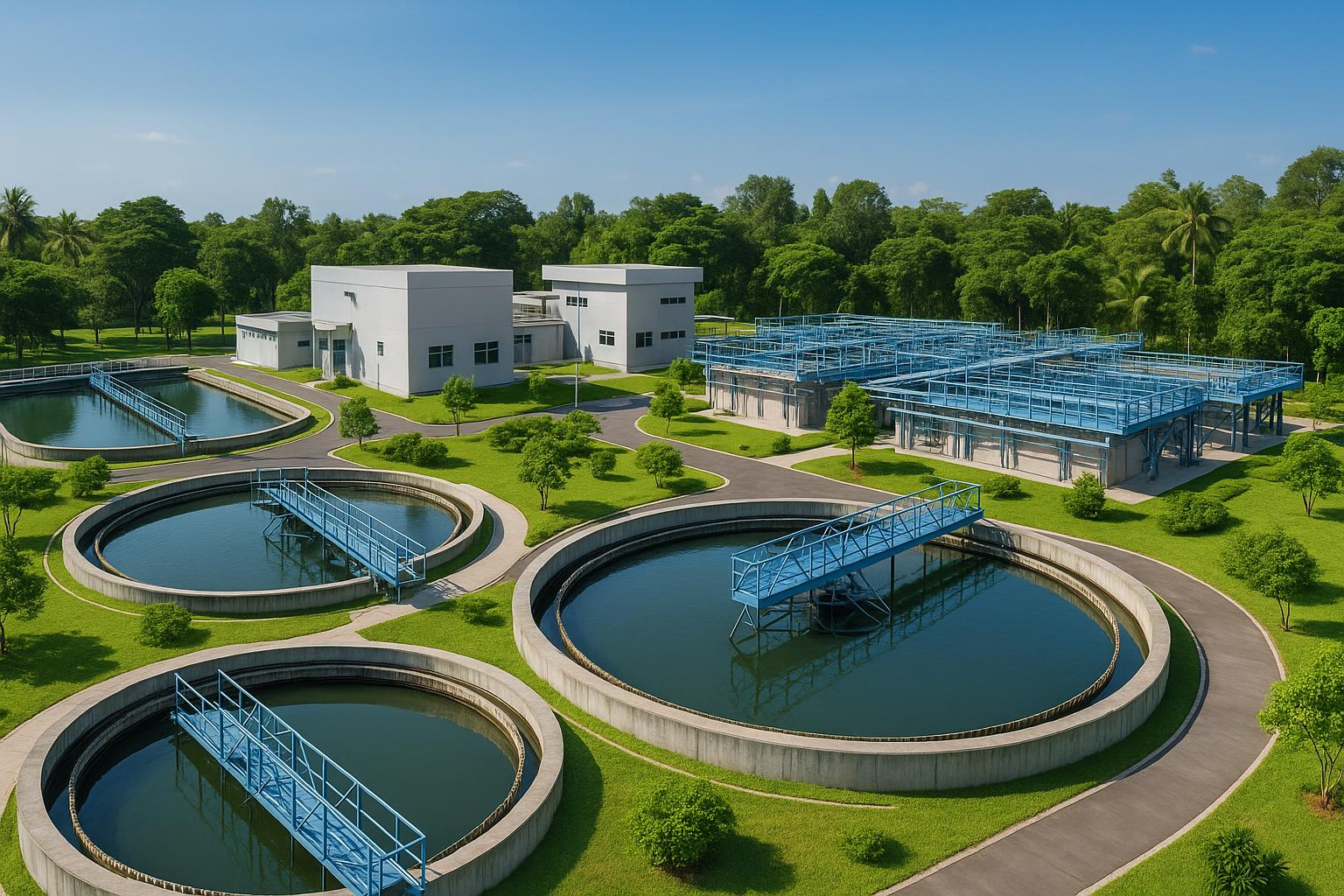
1. Why should we renovate the paint wastewater treatment system towards a biological approach?
Wastewater from paint production primarily arises during equipment washing, cleaning mixing tanks, filtration systems, and workshop cleaning; along with cooling water during grinding to limit solvent evaporation. This discharge often has a high organic load and contains a complex mixture of film-forming agents, pigments, plastic particles, additives, volatile organic solvents, and heavy metals from specific paint streams. Its prominent characteristics include high color, distinctive odor, large TSS due to dispersed pigments and plastic particles, along with organic compounds that are difficult to biodegrade without appropriate pretreatment.
Practical experience shows that relying solely on simple physicochemical methods (coagulation – flocculation – sedimentation) makes it difficult to achieve stability when the load fluctuates, and the cost of chemicals tends to increase over time. Meanwhile, the aerobic biological mass can consume most of the dissolved organic matter, reducing the demand for chemicals, minimizing physicochemical sludge generation, and allowing the system to self-adapt within a certain range of fluctuations. When combining biological processes with selective pretreatment steps (such as Fenton/advanced oxidation), the efficiency of removing difficult-to-degrade organic matter and decolorization will significantly increase, facilitating sustainable biological activity.
For paint factories that are expanding capacity or must meet stricter discharge requirements, choosing biological technology such as MBBR (Moving Bed Biofilm Reactor) or MBR (Membrane Bioreactor) allows for improved efficiency, optimized space, and reduced overload risks. MBBR can increase treatment capacity by adding media in existing tanks, while MBR integrates sedimentation tanks with hollow fiber membranes, producing clear and stable effluent. Both approaches have clear operational quantitative data for adjustment according to business goals.

2. Renovation Goals: Standards, Stability, and Cost Reduction Opportunities
Regarding legal compliance, the system needs to aim for treatment that meets the requirements according to QCVN 40:2025/BTNMT (general industrial wastewater standards) for organic indicators, suspended solids, color, metals, and other relevant parameters applicable to the project. It is not necessary to “race for chemicals” to meet daily targets; instead, design a series of works suitable for the characteristics of paint wastewater, where biological processes play a role in treating the organic base, while physicochemical and advanced oxidation are “placed correctly” to handle difficult targets.
The second goal is stability when the load varies. Equipment washing streams per shift, batch production campaigns, or color formula changes can cause significant fluctuations in COD, TSS, and color. An aerated equalization tank and physicochemical pretreatment line help “flatten” fluctuations; subsequently, separating difficult-to-degrade substances using Fenton/advanced oxidation at a pH of about 3 will reduce the burden on the aerobic biological mass. In the biological mass, both MBBR and MBR are powerful tools to maintain efficiency when organic loads fluctuate.
Finally, there is operational cost. Biological processes help reduce the need for coagulating and flocculating chemicals; MBBR reduces the requirement for area expansion when capacity needs to be increased; MBR reduces the need for sedimentation tanks and provides clear effluent, facilitating internal reuse when required. Particularly, the operational parameters of MBBR and MBR (such as specific surface area of the media, membrane pore size, pumping cycles) are the foundation for accurately controlling energy and chemicals, avoiding “compensating with excessive safety margins” that lead to increased costs.
3. Proposed Biological Technology Diagram for Renovating the Paint Wastewater System
The overall solution should follow the logic: mechanical – physicochemical pretreatment (bar screen, aerated equalization tank, coagulation – flocculation – sedimentation I) to reduce TSS, color, and some COD; followed by advanced oxidation (Fenton/coupling) targeting difficult-to-degrade compounds at suitable pH; then neutralizing to neutral and passing through aerobic biological treatment (Aerotank/AO), or integrating MBBR media to increase biomass density, or using MBR to integrate sludge separation by membrane; finally, disinfection and sludge management. This flexible combination allows for both effectiveness and optimization of OPEX.
3.1. Physicochemical Pretreatment: Coagulation – Flocculation – Sedimentation I to “unpack” TSS and color
At this step, wastewater after the equalization tank is dosed with coagulants (such as PAC/aluminum sulfate) and polymers to bind colloidal particles, pigments, and dispersed plastic particles into large flocs that settle easily. If designed correctly, the color and TSS will significantly decrease, while undissolved COD associated with particles will also be removed. Optimizing the dosing pump placement, rapid – slow mixing times, and uniform stirring in the flocculation tank is key to reducing chemical dosing. It is recommended to conduct jar tests for each different equipment washing batch to adjust the appropriate dosing.
The physicochemical sludge from sedimentation I needs to be collected in a sludge storage tank for pressing, transferring according to industrial waste regulations. A stable coagulation system will create a favorable “foundation” for subsequent steps: clearer water, fewer solids adhering to the membrane surface (if using MBR), and reduced H2O2 consumption in the advanced oxidation step, as there are fewer residues “consuming” the oxidizing agents.
3.2. Advanced Oxidation Fenton/Coupling at pH around 3 to Treat Difficult-to-Degrade Organics
Water after sedimentation I often still contains persistent organic matter and difficult-to-degrade polymer additives. The advanced oxidation stage using Fenton/coupling is recommended to be placed immediately after sedimentation I. The core point is to lower the pH of the wastewater to about 3 using acid (e.g., H2SO4) for effective reactions; then, H2O2 is added as an oxidizing agent along with appropriate catalysts. Practical documents indicate that FeSO4·7H2O and KMnO4 can be used as catalysts/supporting agents to accelerate the degradation of difficult-to-treat organic compounds, reducing color and odor.
After oxidation, the neutralization tank brings the pH back to neutral to protect the aerobic biological cluster downstream. In the neutralization tank, the flocs formed from the oxidation process also settle further, contributing to reducing COD before entering biological treatment. This step directly affects costs: if Fenton operates too “strongly,” H2O2 consumption is high; if the pH does not reach around 3, efficiency significantly declines and “burdens” the biology. Therefore, it is necessary to monitor pH online and control the dosing of H2O2/catalyst according to the actual quality of each production batch, rather than dosing fixed amounts based on flow.
3.3. Aerobic Biological Treatment Using Aerotank/AO to Process Organic Base
After “unpacking” the difficult-to-treat portion, the traditional aerobic tank (Aerotank/AO) is responsible for degrading most of the dissolved organics into CO2, H2O, and microbial biomass. With sufficient air supply and reasonable sludge recirculation, Aerotank creates a stable foundation for the system. However, if the enterprise needs to increase capacity or reduce area, two enhancement options are MBBR or MBR – both based on aerobic biological principles but improving biomass density and/or sludge separation mechanisms.
In the AO configuration, an anoxic tank can be arranged upfront to denitrify if needed, while also facilitating heterotrophic microorganisms to degrade some organic matter. In the aerobic compartment, activated sludge will consume the remaining organic matter. The sedimentation tank II after Aerotank separates sludge – water; sludge is recirculated back to Aerotank to maintain microbial density, while the excess is sent to the sludge storage tank. Although simple and reliable, Aerotank may be limited when the load increases rapidly or in tight spaces.
3.4. Increased Load and Flexibility with MBBR (Moving Bed Biofilm Reactor)
MBBR uses moving media as “housing” for biofilm development, thereby significantly increasing biomass density per unit volume without needing to expand tank area. The media has a hollow structure, specific gravity close to water, and moves continuously with the air flow, creating good contact between microorganisms and substrates. The strength is that it can increase treatment capacity by adding more media; in practice, increasing capacity by about 10–30% has been recorded as feasible simply by increasing the media ratio in the tank, facilitating renovation without major civil changes.
Regarding operational data, MBBR media has a large specific surface area, up to about 3000 m²/m³, helping to increase the growth area for microorganisms without increasing tank volume. BOD treatment efficiency can reach up to 90% when designed, with appropriate oxygen supply and load. For paint factories, MBBR is suitable to be placed after Fenton/neutralization, where the water has significantly reduced inhibitory substances and color, helping the biofilm operate sustainably. It is important to maintain stable aeration to avoid the media becoming stagnant, while also controlling media leakage through the screen at the outlet of the tank.
3.5. Clear Effluent and Small Footprint with MBR (Membrane Bioreactor)
MBR combines aerobic activated sludge with sludge separation using hollow fiber membranes, eliminating the need for sedimentation tank II and providing clear effluent, which is very convenient if the enterprise considers internal reuse (floor washing, irrigation, indirect cooling…) or needs stable quality year-round. In terms of characteristic technical parameters, the membrane pore size is about 0.02–0.1 µm, sufficient to retain activated sludge and most bacteria. The membrane suction pump usually operates in cycles to reduce fouling: a reference cycle is to run for 10 minutes and then rest for 1–2 minutes to “relax the membrane,” reduce pressure differences, and extend membrane lifespan.
Compared to traditional Aerotank, the overall treatment efficiency of MBR can be about 15–35% higher depending on configuration and load, while the construction area is reduced due to the elimination of sedimentation and disinfection tanks. However, MBR is sensitive to coarse particles and oils; therefore, the quality of pretreatment (fine bar screening, sedimentation I, stable Fenton) directly affects operational stability and membrane cleaning costs. When renovating, coarse/fine filtration at the membrane tank inlet and strict control of turbidity indicators for the membrane should be considered.
3.6. Disinfection, Finalization, and Sludge Management
After biological treatment, the water passes through the disinfection stage to control pathogenic microorganisms before discharge. Chlorine or UV lamps can be used; UV has the advantage of not generating halogenated by-products but its effectiveness depends on water turbidity, while chlorine is simple and easy to operate but requires dosage control to avoid unwanted residues. The sludge generated from the biological mass and physicochemical sludge is collected in a sludge storage tank for thickening, pressing, and transferring according to industrial waste regulations.
In the “finalization” stage, online monitoring functions (pH at Fenton, pH after neutralization, turbidity/MLSS in biology, inflow/outflow) should be integrated to automate the control of chemical dosing pumps and air blowers. This approach helps maintain stable performance while also serving as a “lever” to reduce operational costs by dosing chemicals and supplying air according to actual loads – avoiding waste.
4. Expected Treatment Performance When Transitioning to Enhanced Biological Technology
With the physicochemical pretreatment – Fenton at pH around 3 – neutralization – enhanced biological treatment line, difficult-to-degrade organic compounds and color are treated effectively before entering the microbial mass, increasing reliability. At the biological level, if MBBR is chosen, BOD removal efficiency can reach up to 90% when the media, air supply, and load are adjusted appropriately, thanks to the large microbial surface area of about 3000 m²/m³. When replaced with MBR, the treated water will be significantly clearer, and the overall biological system efficiency can be about 15–35% higher than traditional Aerotank, especially useful when the output targets need to be stable year-round.
One important difference is seasonal and production shift stability. Thanks to having “cut off” potential toxicity using Fenton and reducing fluctuations with aerated equalization, the biological tank experiences fewer shock loads. MBBR, with its adhered biofilm, also stabilizes better against short-term fluctuations than pure suspended activated sludge. MBR, thanks to its physical membrane barrier, retains biomass effectively, limits sludge washout, and allows for maintaining high biological concentrations without relying on sedimentation.
It is important to note that actual performance depends on the specific characteristics of wastewater from each factory (solvent-based or water-based paint ratio, type of pigment, degree of VOC mixing in washing water, batch washing mode…). Therefore, before finalizing the choice, jar tests (for coagulation, Fenton) and, if conditions allow, biological pilots with MBBR/MBR according to the proposed configuration should be run to verify stability and optimize parameters.
5. Optimizing Operational Costs: Where Biology Plays the “Lever”
Proper pretreatment at the “drop point” significantly reduces chemical costs. In the Fenton stage, maintaining pH around 3 before dosing H2O2 and catalysts (such as FeSO4·7H2O, KMnO4) provides better oxidation efficiency than dosing in high pH ranges, thus reducing H2O2 consumption. Implement online pH monitoring at the Fenton tank and after neutralization; install cross-signals between pH and chemical dosing pumps to avoid “overdosing safety margins.” Once stable operation is achieved, characteristic dosing-load curves can be input into PLC to control according to flow and color/COD relative to each batch.
Biology is an effective “chemical cutter” once the difficult-to-degrade portion has been eliminated in pretreatment. With MBBR, the flexible capacity increase option by adding media (about 10–30% based on practice) helps avoid tank expansion – a significant CAPEX. With MBR, the economic benefit lies in integrating treatment – sludge separation, reducing sedimentation tanks and area, while providing stable clear water, reducing the need for fine filtration later. Operating MBR in a 10-minute pump run – 1–2-minute rest cycle helps reduce membrane surface fouling, thereby lowering cleaning costs and extending membrane lifespan.
Energy management in the biological tank is also a major point. Aeration accounts for a significant proportion of OPEX; measuring DO at key locations to control the fan inverter according to organic load yields clear results. In MBBR, it is necessary to maintain sufficient flow velocity for the media to move evenly; excess air not only wastes energy but also increases sludge shear, making the water turbid. In MBR, controlling gas washing under the membrane and maintaining appropriate pumping cycles also contributes to reducing overall energy consumption.
Finally, there is sludge. Thanks to biology playing a major role, physicochemical sludge decreases; if MBR is applied, the excess sludge is often lower than traditional sedimentation systems due to longer sludge retention times. Nevertheless, the sludge pumping schedule and pressing method need to be optimized according to actual generation, avoiding “overflowing” and then urgent treatment – which incurs extra costs and odor risks. With operational data, the sludge pressing schedule can be adjusted seasonally and according to production volume.
6. Quick Comparison Table of Biological Options and Pretreatment for Paint Wastewater
The table below summarizes some quantitative data from operational practices and technical documents, helping enterprises quickly assess the pros and cons when renovating the system. Note: the figures are typical technical characteristics and need to be adjusted for each specific project.
| Solution | Quantitative Data (from documents) | Strengths in Treating Paint Wastewater | Operational Notes |
|---|---|---|---|
| Advanced Oxidation Fenton/Coupling | Operating pH around 3; using H2O2 with catalysts like FeSO4·7H2O and KMnO4 | Breaks down difficult-to-degrade organics, reduces color/odor, lessens the burden on biology | Control pH and H2O2 dosing according to load; neutralize to neutral before entering biology |
| MBBR (Moving Bed Biofilm Reactor) | Media surface area up to about 3000 m²/m³; BOD efficiency can reach up to 90%; can increase capacity by about 10–30% by adding more media | Increases biomass density without needing to expand tanks; withstands load fluctuations well | Maintain sufficient aeration for media movement; media screen at the outlet |
| MBR (Membrane Bioreactor) | Membrane pore size about 0.02–0.1 µm; reference pump cycle: run 10 minutes – rest 1–2 minutes; treatment efficiency can be about 15–35% higher than Aerotank | Clear, stable effluent; reduces area by eliminating sedimentation tank; convenient if reuse is needed | Technical pretreatment to reduce membrane fouling; optimize gas wash cycle to extend lifespan |
| Traditional Aerotank/AO | — | Simple configuration, easy to operate; a foundation for integrating MBBR/MBR | Limited when loads increase rapidly or in tight spaces; dependent on sedimentation tank II |
The reasonable combination of the above blocks helps “treat the right disease with the right medicine”: targeted pretreatment for color and persistent organics, biological treatment for organic base, and membranes/media to enhance stability – all serving the goal of effluent meeting QCVN 40:2025/BTNMT and optimizing costs.
7. Feasible Renovation Roadmap for Paint Factories
Start with a detailed survey: collect samples representative of production batches, especially equipment washing water for each product line; check fluctuations in TSS, color, odor, and signs of VOCs/difficult-to-degrade organics through simple experiments. Concurrently, assess the condition of existing tanks: equalization volume, aeration capacity, settling level, sludge line, and space for MBBR/MBR.
Next, conduct jar tests for coagulation – flocculation and Fenton/coupling at pH around 3 to establish the dosing – initial effectiveness window, check settling rates and color reduction capability before entering biological treatment. If conditions allow, run small-scale pilots with MBBR (adding media according to the planned ratio) or MBR (hollow fiber membrane with a 10-minute pump run – 1–2-minute rest) to evaluate stability, fouling levels, and gas wash requirements.
After finalizing the configuration, implement renovations in stages to maintain continuous operation: (1) optimize equalization tank and coagulation – sedimentation I; (2) install Fenton/neutralization units; (3) integrate MBBR or MBR; (4) finalize disinfection, sludge line; (5) add online monitoring (pH, flow, turbidity/MLSS) and integrate automatic control for chemical dosing/air supply. This staged approach reduces the risk of machine downtime, helping the operational team gradually adapt and fine-tune parameters according to actual data.
8. Common Operational Errors and Solutions When Applying Biology
A common error is treating Fenton as a “lifesaver” and dosing chemicals at fixed rates regardless of load fluctuations. The consequence is increased H2O2 costs, with disproportionate effectiveness if pH is not maintained around 3. The solution is to install online pH measurement, standardize the acidification process before dosing H2O2, and adjust dosing according to actual turbidity/color for each batch. After Fenton, it is necessary to neutralize to neutral before biological treatment to avoid inhibiting microorganisms.
In MBBR, two typical risks are media becoming “stagnant” due to insufficient air supply and media leaking through the outlet due to inappropriate screens. Both lead to reduced efficiency: the biofilm is not adequately swept, resulting in localized thickening and peeling; media leakage causes pump jams/damage to equipment. Solutions include adjusting airflow according to load (ensuring even movement throughout the tank) and using media screens with appropriate gaps that are easy to clean.
With MBR, membrane fouling is the primary concern. If the influent still contains fine particulates, polymers, or oils, the membrane quickly experiences increased pressure differentials and requires more cleaning. The solution is to improve pretreatment quality (fine bar screening, optimized sedimentation I, stable Fenton), operate according to the correct suction cycle (10 minutes run – 1–2 minutes rest), and maintain even gas washing under the membrane cluster. Schedule periodic chemical cleaning according to the membrane manufacturer’s recommendations, avoiding “waiting until the pressure differential is too high before cleaning,” which can reduce membrane lifespan.
One final point is the coordination of chemicals. Residual coagulant polymers can adhere to MBBR media or MBR membranes if dosed too high, reducing contact efficiency or increasing fouling. The operational team should monitor for unusual foaming, water viscosity in the biological tank, and adjust polymer dosing at the sedimentation I stage accordingly, while also considering changing polymer types when necessary.
9. Frequently Asked Questions (FAQ)
1) Why must pH around 3 be maintained in the Fenton/advanced oxidation tank?
In practice, a pH of around 3 is favorable for effective Fenton reactions, helping H2O2 and catalysts (such as FeSO4·7H2O, KMnO4) decompose persistent organic compounds, reducing color and odor. If the pH is much higher, oxidation efficiency significantly decreases, and chemical costs increase due to ineffective consumption.
2) When should MBBR be chosen over MBR in renovations?
If the main goal is to increase capacity and stability against load fluctuations without expanding area, MBBR is very suitable as it can increase capacity by about 10–30% by adding media and has a large microbial surface area of about 3000 m²/m³. If clear, stable effluent is required and a compact area is needed, MBR will have an advantage.
3) Does MBR really provide higher efficiency than traditional Aerotank?
MBR typically achieves overall treatment efficiency about 15–35% higher than Aerotank due to its sludge separation mechanism using membranes and maintaining high biomass concentrations. Additionally, the membrane pore size of about 0.02–0.1 µm helps retain sludge and most bacteria, producing clear and stable effluent.
4) Is the BOD treatment efficiency of MBBR reliable?
With proper design and stable operation, MBBR can achieve BOD removal efficiency of up to about 90%. It is essential to ensure sufficient aeration for media movement and place MBBR after pretreatment (coagulation – sedimentation, Fenton) to reduce inhibitory substances for microorganisms.
5) How should the pump cycle of MBR be set when starting operation?
A reference cycle is to run for 10 minutes and rest for 1–2 minutes to reduce membrane surface fouling and pressure differentials. Based on actual pressure differential data, adjustments can be made gradually to optimize between stability, energy consumption, and membrane washing frequency.
6) Will the system after renovation meet discharge standards?
When correctly combining the pretreatment blocks, advanced oxidation at suitable pH, along with enhanced biology using MBBR or MBR, the system has the basis for stable operation and aims to meet QCVN 40:2025/BTNMT. It is recommended to verify through jar tests/pilots before finalizing the configuration to reduce risks and optimize costs.
Nanoen
NANO THANG LONG ENVIRONMENTAL COMPANY LIMITED
Hanoi Office: No. 15 TT18 Van Phu Urban Area, Ha Dong, Hanoi
Can Tho Office: 661E/29, Vo Van Kiet Street, Binh Yen A Area, Long Hoa Ward, Binh Thuy District, Can Tho City
Ho Chi Minh City Office: 533/12/7, Pham Van Bach Street, Ward 15, Tan Binh District, Ho Chi Minh City
Hotline: 0986.689.781 - 0969.054.226
Email: thanglongnanoen@gmail.com
Facebook: www.facebook.com/thanglongnanoen