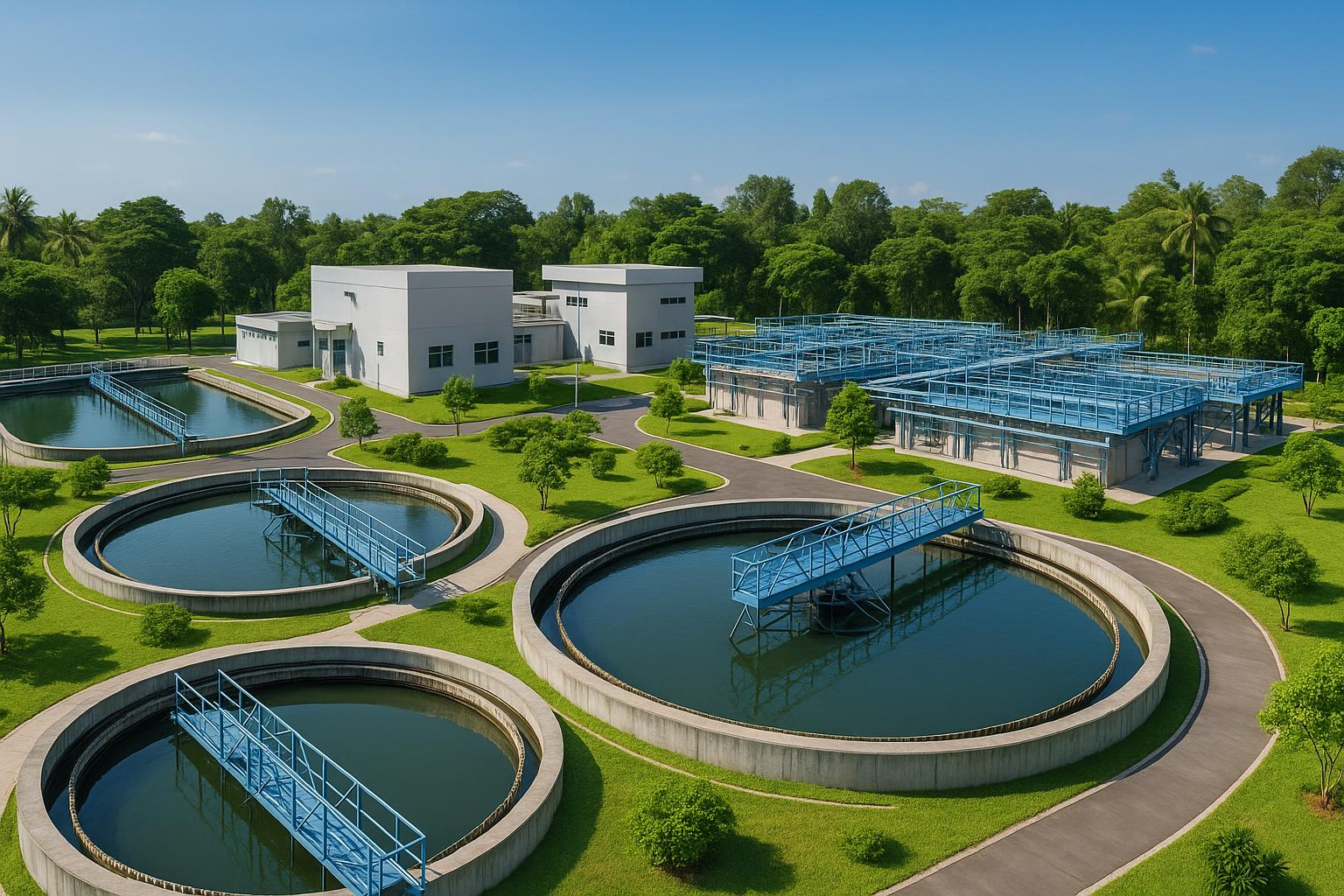
1. Context of renovating the wastewater treatment system in the beer industry and compliance requirements
The beer production industry in Vietnam is continuously expanding its capacity, leading to increasing pressure on wastewater treatment. Most facilities operating the system were built during the initial investment phase, and now have reached the load threshold due to overtime, batch increases, product changes (lager, ale, specialty beer), and increased equipment cleaning activities. Renovating the system towards a biological-chemical combination is a safe strategy to meet discharge quality while optimizing costs and flexibility when increasing capacity. The technical focus often revolves around the anaerobic cluster (UASB), aerobic tank (MBBR or Aerotank), equalization – flow splitting, and operational bottlenecks such as sedimentation – disinfection – sludge.
Legally, industrial wastewater from breweries when discharged into the environment must meet the standards applicable to industrial wastewater. Enterprises should use QCVN 40:2025/BTNMT and the accompanying documents issued with Circular 06/2025/TT-BTNMT as target standards when designing and accepting discharge quality. When renovating, it is necessary to clearly identify the receiving source, corresponding target columns, and conditions for continuous – periodic control. The role of the intermediate step of online measurement (pH, flow rate, high – low load flow splitting) is crucial to ensure system stability and sustainable compliance.

2. Characteristics of brewery wastewater and design implications
Wastewater in the beer industry varies significantly according to production shifts and CIP schedules. Technical documents record two main groups of discharge streams. The high pollution load stream comes from beer filtration, cooking, and washing fermentation tanks – storage tanks, with COD potentially reaching about 10,000 mg/L. The lower load group comes from bottle washing, floor washing, and disinfection, with COD around 200 – 300 mg/L. The BOD/COD ratio of brewery wastewater is at 0.6 – 0.7, indicating good biodegradability and suitability for applying biological technologies as a treatment foundation.
Regarding wastewater standards, technical sources show that data is quite dispersed according to technology and operational organization. Some documents state that wastewater volume is about 2.5 – 6 m3/1000 liters of beer, while other studies record 8 – 14 liters of wastewater for each liter of finished beer. This difference often arises from the level of recycling – reuse of washing water, the level of CIP automation, and cleaning intensity. Therefore, when renovating the system, it is necessary to reassess peak hour flow, water balance per shift, and establish load curves to determine the adequate equalization volume to handle peak fluctuations, rather than relying solely on daily averages.
2.1. Typical components and their impact on technology
Brewery wastewater is rich in easily degradable organic compounds (carbohydrates, proteins, fermentation by-products), and may also contain soda, caustic soda (NaOH), H3PO4, CaSO4, CaCO3… from the washing – adjustment process. The pH varies widely if not balanced in time. When entering the anaerobic cluster, too low a pH will inhibit methanogens; conversely, too high a pH due to CIP alkalinity can disrupt the structure of the sludge particles. Prior to UASB, neutralizing to a pH of about 6.5 – 7.5 is essential to protect the anaerobic microbial population.
Suspended solids (SS) from malt residues, filter aids, and yeast can spike due to overflow or improper washing procedures. The input conditions for the anaerobic cluster usually require SS below a high threshold (for example, documents state below 3,000 mg/L) to limit the washout of sludge particles and prevent rapid thickening of sludge. Therefore, mechanical pretreatment – primary sedimentation and operational management at the source (especially for yeast – filter aid storage tanks) is key to reducing risks for the entire treatment line.
2.2. Design – operation implications for the biological block
With a BOD/COD ratio of 0.6 – 0.7, choosing a biological foundation is reasonable, combining: anaerobic (significantly reducing organic load, recovering biogas), followed by aerobic treatment to handle the remaining organic matter and nutrients. In the UASB tank, documents record an available organic load range of about 10 – 15 kgCOD/m3.day, with an optimal pH range of 7 – 7.2 and a temperature of 33 – 35°C. Within that range, the conversion process through hydrolysis – acidification – acetate formation – methanogenesis occurs effectively; the removal efficiency of BOD, COD, and phosphorus can reach about 80% depending on actual conditions.
The aerobic block can be an activated sludge Aerotank or MBBR. With fluctuating loads, MBBR creates a three-zone biofilm (aerobic – anoxic – anaerobic) on the carrier, allowing for both organic oxidation and nitrogen nitrification/denitrification, while also supporting biological phosphorus removal. If there is already an Aerotank, it can be renovated in the form of “adding media” to increase biomass density without expanding volume – a typical measure when increasing capacity in limited land.
3. Combined chemical – biological technology diagram for capacity increase
The general diagram for renovating the beer industry system usually includes: bar screen – collection/equalization pit – pH neutralization – (coagulation/flotation if needed) – primary sedimentation – UASB – intermediate tank – MBBR/Aerotank – secondary sedimentation – disinfection – standard pond/tank. The key points for increasing capacity are: (i) stabilizing flow and pH before anaerobic treatment; (ii) maintaining – developing UASB sludge particles to withstand high loads; (iii) increasing aerobic microbial density (MBBR media or improved aeration – sludge recirculation); (iv) preventing bottlenecks in sedimentation and disinfection.
In implementation, it is necessary to identify the actual “limiting points”: gas escape rate and three-phase separation zone in UASB; gas/oxygen distribution capability of the aeration system in the aerobic tank; hydraulic load of the sedimentation tank; and residual disinfection at the discharge end. Operational data for several continuous weeks by hour (COD, SS, pH, flow rate, sludge condition) is the basis for locking upgrade parameters: adding equalization tanks, adding recirculation lines, or renovating distribution pipes in UASB to reduce flow channels.
3.1. Mechanical pretreatment and flow – concentration equalization
Bar screens and fine screens help remove large solids and filter aids before entering the collection pit. The equalization tank has continuous aeration/mixing to prevent sedimentation, eliminate COD peaks, balance temperature – pH, and is the optimal location for neutralization. In the beer industry, separately collecting high and low load streams and then regulating according to the “loading window” of UASB/aerobic treatment often yields significant efficiency without immediately increasing tank volume.
The chemical neutralization step should be automated with acid/base dosing pumps according to online pH signals, locking in appropriate targets before anaerobic treatment (documents recommend around 6.5 – 7.5). This is also a convenient point to add flocculants/coagulants when SS or color spikes due to production incidents, helping to reduce the burden on downstream tanks.
3.2. Coagulation – flotation: use when needed, at the right time
Under normal conditions, brewery wastewater may not require strong chemical treatment if the biological cluster is healthy and stable. However, when incidents such as beer overflow, immature beer, or unexpected yeast tank washing occur, applying coagulation – flocculation and dissolved air flotation (DAF) in batches can prevent biological “breakdown.” Timely chemical treatment helps rapidly reduce SS and open organic matter, restoring safe input conditions for UASB and MBBR/Aerotank.
A point to note is that excess chemicals can affect microorganisms (for example, high aluminum/iron affects sludge sedimentation, large pH fluctuations inhibit anaerobic processes). Therefore, all chemical applications should be linked to end-to-end monitoring and an “on/off” mechanism based on incident signals, avoiding continuous dosing when unnecessary.
3.3. UASB – the anaerobic core to handle high loads
UASB is an anaerobic tank with upward flow through a granular sludge layer, where organics are converted into a mixture of CH4 and CO2. According to technical documents, UASB operates effectively in a temperature range of about 33 – 35°C, pH around 7 – 7.2, and can withstand an organic load of about 10 – 15 kgCOD/m3.day if the sludge particles develop well and hydraulic distribution is even. Input conditions also recommend SS not exceeding high levels (documents state below 3,000 mg/L) to limit sludge particle washout and clogging in the distribution area.
In actual renovations, two items often create a “jump” for UASB: optimizing the bottom distribution system (even distribution, reducing flow channels) and improving the three-phase separation zone (gas – sludge – water) to retain sludge particles and prevent foam from pulling sludge out. When stable, UASB can remove most BOD/COD and even phosphorus at high levels (documents record up to about 80%), significantly reducing size/cost for the subsequent aerobic block.
3.4. MBBR or Aerotank – “polishing” quality and nutrient removal
After anaerobic treatment, the intermediate tank helps wastewater “adapt” before entering aerobic treatment. With traditional Aerotank, it is necessary to ensure appropriate oxygen supply and sludge recirculation to oxidize the remaining organic matter and perform nitrification/denitrification when the configuration allows. Meanwhile, MBBR uses suspended media to increase biomass density and create an oxygen gradient in the biofilm, thereby simultaneously treating organics and removing nitrogen/phosphorus directly on the biofilm layer.
When increasing capacity in limited land, a common approach is to install media in the existing aerobic tank to convert it to MBBR or IFAS. By increasing biomass density, the same tank volume can handle larger flows or withstand peak loads better. It is necessary to optimize the aeration system to provide oxygen while keeping the media evenly suspended, avoiding “clumping” in dead zones.
3.5. Secondary sedimentation and disinfection – the final checkpoint
The secondary sedimentation tank separates sludge from water; part of the sludge is recirculated back to aerobic treatment (if Aerotank/IFAS), and the excess is sent for dewatering. When expanding capacity, the sedimentation tank often becomes a “bottleneck” due to rapidly increasing hydraulic loads. Improvements such as inclined sedimentation plates, uniform collection troughs, and proper sludge management will help maintain stable clarity at the output even when flow rates fluctuate.
Disinfection with chlorine, UV, or ozone is the final step to kill pathogens before discharge. For the beer industry, chlorination is an economical choice, as long as the dosage is controlled appropriately and the contact time is sufficient. In cases where the receiving water is sensitive to residual chlorine, UV is an alternative solution. Regardless of the technology chosen, the goal is to ensure that the treated water meets the applicable standards according to QCVN 40:2025/BTNMT.
3.6. Sludge management and biogas recovery
Sludge generated from UASB is less than that from the aerobic line due to the low anaerobic biomass yield coefficient. Sludge from UASB and secondary sedimentation should be collected into a sludge storage tank and then dewatered; the separated water should be returned to the head of the system. For UASB, it is necessary to periodically check the sludge particle layer, the ratio of healthy – weak particles to decide on sludge withdrawal/maintenance, avoiding sludge accumulation that reduces efficiency and increases the risk of particle washout under high loads.
Biogas from UASB mainly consists of CH4 and CO2; if conditions allow, it can be recovered to replace part of the boiler fuel. This is a “dual” benefit when renovating: reducing organic load while increasing energy efficiency. When implementing, it is necessary to equip moisture separation, fire safety, and emergency gas discharge according to standards.
4. Increasing capacity: renovation scenarios and operational optimization
Not every project requires expanding tanks to increase capacity. In many cases, the goal can be achieved by optimizing flow splitting and improvements in existing tanks. For example, separating high load streams (beer filtration, yeast tank washing) through UASB in batches, while low load streams continuously go through equalization – aerobic treatment, helps UASB operate within an optimal load range of nearly 10 – 15 kgCOD/m3.day instead of “bobbing” by hour. At the same time, redesigning the bottom distribution pipes and the three-phase separation zone helps increase the ability to retain sludge particles – a crucial factor when pushing capacity.
In the aerobic line, adding media to convert Aerotank to MBBR/IFAS configuration often yields significant results in existing land. By increasing local microbial density, the system can handle additional flow and fluctuations without significantly increasing sedimentation volume. With MBBR, it is necessary to reassess the aeration system to avoid oxygen deficiency and ensure even movement of the media, as this is a condition for the biofilm to form three layers (aerobic – anoxic – anaerobic) as described in the documents.
4.1. Stabilizing UASB when increasing load
When increasing organic load, the risk of acidification in the anaerobic tank and pH drop is present. Therefore, arranging online pH monitoring at the equalization tank, maintaining neutralization at an appropriate range before UASB (for example, 6.5 – 7.5 as recommended) is the first “barrier.” At the same time, controlling the temperature within the favorable range (about 33 – 35°C according to documents) helps methanogenic microorganisms maintain high activity, reducing the accumulation of volatile acids.
Keeping healthy sludge particles is an ongoing goal. “Nurturing” the particles by avoiding alkaline/acid shocks, limiting sudden SS spikes, and optimizing three-phase separation will help maintain load tolerance near the range of 10 – 15 kgCOD/m3.day. If the sludge ages, consider batch withdrawal combined with “seeding” good particles from the healthy compartment to the weak compartment to rejuvenate the system.
4.2. Increasing aerobic microbial density with media
Reinforcing the aerobic tank with MBBR media or IFAS configuration is a “typical” approach when increasing capacity. The advantage is that it does not require significant volume expansion; the downside is the need to rebalance aeration, mixing, and update sludge separation strategies in the sedimentation tank. With a three-layer biofilm, the system can simultaneously oxidize organics and effectively remove nitrogen in the same tank volume.
When installing media, it is necessary to check bar screens and mesh screens at the inlet and outlet of the tank to avoid losing media. At the same time, adjust the operating mode (changing retention time between compartments, regulating sludge recirculation if IFAS) to ensure both suspended sludge and biofilm work effectively.
4.3. Flow splitting and coordinating cleaning shifts
CIP and yeast tank washing create significant peaks in both organic and chemical loads. Working with the production department to stagger cleaning times, synchronized with the “load swallowing” capacity of UASB – aerobic treatment will significantly reduce fluctuations. Technically, we can use the equalization tank as a “smart buffer,” activating chemical treatment (coagulation – flotation) as needed to block abnormal SS/organic “waves.”
Replanning the internal collection pipe network to separate the “heavy – light” lines, along with directional valves based on local pH/COD signals, is a low-cost but highly effective measure to maintain biological stability. This strategy is particularly useful when needing to quickly increase capacity without having time to expand tanks.
5. Investment – operational costs: determining factors and control methods
Although it is impossible to set a specific figure without field data, it can be confirmed that the largest cost component in renovating the system is the construction – main equipment (UASB, aerobic, sedimentation), aeration systems and media (if choosing MBBR/IFAS), sludge dewatering equipment, along with monitoring – control systems (pH, flow rate, sometimes rapid COD/UV). The optimization problem of capacity/capital often leans towards solutions that “increase biomass density” and “stabilize inputs” rather than massively expanding tank volumes.
Regarding operation (OPEX), energy costs for aeration are significant, followed by chemicals (neutralization, disinfection, coagulation – if needed), sludge treatment, and maintenance. To control OPEX, it is necessary to: (i) keep UASB operating in a high-performance zone to reduce the load on aerobic treatment; (ii) optimize oxygen supply according to actual needs, avoiding excessive aeration; (iii) operate chemical treatment based on events rather than continuously; (iv) stabilize sludge to reduce polymer – energy costs during sludge dewatering. When possible, recovering biogas to replace part of the boiler fuel will soften the overall energy costs of the plant.
6. Effective operation: control processes and common errors
The pillar of effective operation is data. Continuously recording pH, flow rate, SS, COD by shift; logging production events (CIP, washing, incidents) to trace fluctuations; and adjusting flow splitting – neutralization strategies based on reality. The boundary between a stable system and overload is often the equalization step and making early decisions when noticing unusual changes in pH, foam, odor, or sludge.
Common errors include: pH shocks causing UASB sludge particles to “drop,” high SS due to filter aid overflow, foam pulling sludge out of the three-phase separation zone, oxygen deficiency in the aerobic tank after increasing load without upgrading aeration, and “bottlenecks” in the sedimentation tank when pushing flow. Remedies focus on: stabilizing neutralization before anaerobic treatment; implementing chemical treatment based on events; supplementing – adjusting the aeration system; and improving surface water collection, increasing effective sedimentation area (for example, inclined sedimentation plates) when needed.
6.1. UASB control
Maintaining optimal pH before the tank (documents state 6.5 – 7.5) and in the tank (around 7 – 7.2) is core to stabilizing methanogens. When the temperature drops below the favorable range (around 33 – 35°C according to documents), activity decreases significantly; therefore, seasonal operation, insulating – shielding the tank may be necessary at some facilities.
Regularly monitor the structure of sludge particles; if broken particles, floating bubbles, or unusually increased SS in the outflow are observed, it is necessary to temporarily reduce the load, adjust neutralization, and reconsider the bottom water distribution system to eliminate flow channels. The goal is to bring the system back to an organic load that documents consider safe (10 – 15 kgCOD/m3.day) when the sludge is healthy.
6.2. MBBR/Aerotank control
For MBBR/IFAS, ensuring that the media moves freely and is evenly distributed is a condition for forming the three-zone biofilm (aerobic – anoxic – anaerobic), thereby optimizing both organic treatment and nitrogen removal as described in the documents. If the media clusters, it is necessary to check the aeration system, mixing orientation, and mesh screens.
With Aerotank, when increasing load without adding media, it is necessary to reassess the oxygen supply and sludge recirculation strategies to avoid oxygen deficiency and “aging” sludge. Increasing hydraulic loads will accelerate the velocity through the sedimentation tank; therefore, any capacity increase should be accompanied by an assessment of sedimentation hydraulics and improvement solutions if signs of sludge pulling are observed.
6.3. Chemical treatment and disinfection
Neutralization should be linked with online pH measurement and dosing pumps to avoid fluctuations. Coagulation – flotation should only be activated when SS/organic levels spike due to events, avoiding misuse that increases costs and affects microorganisms. Any chemical changes need to be monitored for their impact on sludge sedimentation to avoid creating additional “bottlenecks” in the sedimentation tank.
Disinfection with chlorine, UV, or ozone must ensure “sufficient – correct” rather than “more – safe.” With chlorine, it is necessary to manage residuals and contact time; with UV, it is essential to maintain the clarity of the water after sedimentation to avoid performance degradation. The ultimate goal remains compliance with discharge quality according to QCVN 40:2025/BTNMT.
6.4. Safety, odor, and energy
UASB generates volatile gases; therefore, the gas collection – moisture separation – flare/consumption system must be fully safe. Regarding odor, the equalization and anaerobic areas need to be shielded and properly ventilated. In terms of energy, optimizing aeration according to actual needs after UASB operates well will yield significant benefits, especially when biogas can be utilized for the boiler.
All operational changes should be based on batch – shift experiments and monitored AFTER changes for at least a few production cycles. The “small – fast – measure” approach helps avoid risks and recognize unwanted side effects early.
7. Reference data table for design – operation
| Item/Parameter | Reference Value | Technical Notes |
|---|---|---|
| High load COD | Up to about 10,000 mg/L | Generated from beer filtration, cooking, washing fermentation/storage tanks |
| Low load COD | About 200 – 300 mg/L | Generated from bottle washing, floor washing, disinfection |
| BOD/COD ratio | 0.6 – 0.7 | Indicator of biodegradability, favorable for biological technology |
| Optimal UASB pH | Around 7 – 7.2 | Maintain stability to protect methanogens |
| UASB temperature | Around 33 – 35°C | Favorable range according to technical documents |
| UASB organic load | About 10 – 15 kgCOD/m3.day | Requires healthy sludge particles, even hydraulic distribution |
| pH adjustment before anaerobic treatment | Around 6.5 – 7.5 | Neutralization in the equalization tank to avoid anaerobic shock |
| Input SS for UASB (recommended) | Below about 3,000 mg/L | Reduce the risk of washout, clogging |
| UASB performance (BOD, COD, P) | Up to about 80% | Depends on actual operating conditions |
| Wastewater volume | 2.5 – 6 m3/1000 liters of beer | Depends on technology and operational organization |
| Other studies on discharge rates | 8 – 14 L of wastewater/L of beer | Higher values in some studies, depending on technology |
8. Compliance with standards and strategies to demonstrate compliance
No matter how optimized the technology is, it must “speak” through discharge data. The compliance roadmap should closely follow the target standards applicable according to QCVN 40:2025/BTNMT (issued under Circular 06/2025/TT-BTNMT). Enterprises need to build appropriate monitoring plans, including continuous monitoring of some on-site indicators (pH, flow rate) and periodically sampling for analysis of chemical – microbiological indicators as required.
When renovating, it is advisable to organize a supervised trial phase (usually several weeks to months), operating under various load conditions to “diagnose” early. Any configuration adjustments (adding media, changing flow splitting strategies, altering neutralization) need to have pre-and post-logs, comparative records, serving as the basis for internal acceptance and dialogue with regulatory authorities when necessary.
9. Conclusion: A feasible renovation roadmap for breweries
A feasible, low-risk renovation roadmap often starts with stabilizing inputs (equalization, neutralization, smart flow splitting), optimizing the anaerobic core (UASB) regarding distribution – particle retention – three-phase separation zone, then increasing aerobic biomass density with MBBR/IFAS media or improving Aerotank, along with addressing “bottlenecks” in sedimentation – disinfection. This approach is suitable for the characteristics of brewery wastewater: high organic content but good degradability, fluctuating according to cleaning shifts, and having the advantage of biogas recovery.
In the context of expanding capacity and increasingly stringent environmental requirements, the right combination of biological and chemical processes, data-driven operations, along with a clear compliance plan according to QCVN 40:2025/BTNMT will help enterprises ensure stable outputs while optimizing investment – operational costs. The key remains “right technology – right bottleneck – right timing,” implementing each step confidently and measuring effectiveness.
10. Frequently Asked Questions (FAQ)
1) Why prioritize UASB for brewery wastewater?
Brewery wastewater has a BOD/COD ratio of 0.6 – 0.7 and many easily degradable compounds, making it very suitable for anaerobic treatment. UASB helps significantly reduce COD at high loads (documents state up to 10 – 15 kgCOD/m3.day) and generates biogas, reducing costs for subsequent aerobic treatment.
2) When is chemical treatment (coagulation – flotation) needed?
When sudden events occur such as filter aid overflow, yeast tank washing causing high SS/organic levels, activating chemical treatment in batches will “protect” the biological process. Normally, if the biological process is stable, continuous chemical treatment is unnecessary to avoid chemical waste and impact on sludge.
3) How does MBBR differ from traditional Aerotank in renovations?
MBBR uses media to increase biomass density and create a three-layer biofilm (aerobic – anoxic – anaerobic), effectively treating organics and nutrients in the same volume. When increasing capacity in limited space, adding media to existing tanks is a way to enhance treatment capacity without building larger tanks.
4) What are the important optimal parameters for UASB?
According to documents, an optimal pH range of 7 – 7.2 and a temperature of about 33 – 35°C are favorable, along with an organic load of about 10 – 15 kgCOD/m3.day when the sludge is healthy. Prior to UASB, neutralizing to around 6.5 – 7.5 helps avoid shocks and protect the anaerobic population.
5) Why do sedimentation tanks often become “bottlenecks” when increasing capacity?
When increasing flow, the hydraulic load through the sedimentation tank increases rapidly, reducing effective sedimentation time and easily pulling sludge. Solutions include optimizing sludge recirculation while improving sedimentation structures (inclined sedimentation plates, uniform collection troughs) to enhance sludge separation efficiency in the existing area.
6) How to increase capacity while ensuring compliance?
A phased approach: stabilize inputs – optimize UASB – increase aerobic density – address bottlenecks in sedimentation/disinfection, along with supervised trial runs. Establishing a monitoring plan and aligning targets according to QCVN 40:2025/BTNMT helps demonstrate compliance consistently.
Nanoen
NANO THANG LONG ENVIRONMENTAL COMPANY LIMITED
Hanoi Office: No. 15 TT18 Van Phu Urban Area, Ha Dong, Hanoi
Can Tho Office: 661E/29, Vo Van Kiet Street, Binh Yen A Area, Long Hoa Ward, Binh Thuy District, Can Tho City
Ho Chi Minh City Office: 533/12/7, Pham Van Bach Street, Ward 15, Tan Binh District, Ho Chi Minh City
Hotline: 0986.689.781 - 0969.054.226
Email: thanglongnanoen@gmail.com
Facebook: www.facebook.com/thanglongnanoen