1. Overview: Why the Cyclone + Fabric Filter System is the Optimal Solution for Wood Dust
Wood dust generated from sawing, planing, sanding, CNC, and transportation - sorting lines often has a high load, a wide particle size range (from coarse to fine), fibrous properties, is easy to adhere, and poses a fire and explosion risk. This characteristic makes it difficult for a single technology to simultaneously meet the goals of quickly separating coarse particles, maintaining stable resistance, controlling fine dust, and operating sustainably. Therefore, the combination of Cyclone (pre-treatment) and fabric filters (baghouse) has become the preferred configuration in the wood industry: the Cyclone handles a large volume of dust and heavy particles right at the inlet, reducing the load on the baghouse; the remaining fine dust is retained by the fabric filter before returning clean air.
In terms of efficiency, the Cyclone achieves high performance with large particles; published technical data shows that with particles ≥10 µm, the Cyclone can remove 95–98% right at the pre-treatment stage. When combined with fabric filters, the overall efficiency of the system can reach very high levels; commercial baghouse systems are introduced with filtration efficiency of about 99.8% when selected and operated correctly, helping the treated air meet internal environmental management requirements and applicable standards. This technology pair thus helps reduce the size - cost of the baghouse due to load sharing, while maintaining stable pressure, limiting clogging, and extending the bag cleaning cycle.
From an operational perspective, the Cyclone has a simple design, few moving parts, and good resistance to coarse dust - heat; while the baghouse allows for “fine-tuning” of the output air quality by selecting bag materials (Polyester, Nomex, PPS, Acrylic, PTFE…) and dust cleaning mechanisms (compressed air pulses, reverse pressure, mechanical shaking). For wood dust, compressed air pulses are often the preferred choice due to their reliability and ability to clean the filter surface when the dust tends to lightly clump due to resin - essential oils in the wood.
Finally, fire and explosion safety is the number one concern with wood dust. When the Cyclone is placed in front, the probability of sparks - embers going directly into the bag chamber is significantly reduced due to impact - kinetic energy reduction in the vortex flow. Along with that, specialized explosion suppression solutions can detect events in milliseconds and activate the discharge of extinguishing agents, contributing to pressure control and protecting property and people.

2. Legal Requirements and Post-Treatment Air Quality Criteria
For wood processing facilities, the design - construction of dust treatment systems is not only to ensure a safe working environment but also to comply with current legal requirements. When developing projects and putting them into operation, businesses need to review the applicable standards - criteria for industrial emissions according to the management guidelines of state agencies. In practice, regulatory documents at the circular level play a framework role in applying national technical standards for air; businesses should compare the scope of application, subjects, evaluation methods, and compliance declaration methods according to the currently effective legal documents.
During this process, reference can be made to Circular 45/2024/TT-BTNMT on national technical standards in the field of air, to clearly understand the principles of applying standards related to air emissions and managing the quality of output air. Depending on the nature of the technology, scale, and location of the facility, specialized agencies will guide the application of corresponding requirements. Therefore, the technical problem should start from the output goal of “compliance with regulations”, then interpolate backwards to design the Cyclone - fabric filter cluster, fan, duct, suction hoods, dust discharge - collection mechanisms, and appropriate explosion safety solutions. In all cases, absolutely avoid general assumptions; it is necessary to carefully read the scope - context of the document before drawing conclusions.
3. Design Process for Wood Processing Plant Systems
3.1. Surveying Dust Sources and Characteristics
The initial survey must fully identify emission points: saw machines, planers, belt - disc sanders, routers/CNC, dryers, loading and unloading stations, and hoppers - silos for transportation. For each group of equipment, it is necessary to describe the type of dust (sawdust, wood chips, sanding dust), adhesion tendencies due to resin - glue, and spark generation potential (e.g., due to knife jams, friction). The survey results will influence the configuration of the suction hoods, duct layout, and load distribution ratios to branches. Attention should be paid to positions with large variations in operating modes (equipment running - stopping in batches), as the system needs to maintain stable total flow and avoid dust backflow phenomena.
Particle characteristics are key to “choosing roles” between the Cyclone and the fabric filter. Wood dust often has a significant portion of coarse - fibrous particles; technical documents show that the Cyclone removes most particles ≥10 µm with an efficiency of 95–98%, making it very suitable as a “coarse filter” to reduce the load on the bags. Conversely, the remaining fine particles will require fabric filters to achieve very high filtration efficiency; baghouse systems are reported to achieve around 99.8% if the filter material and cleaning mechanism are suitable for the dust - air characteristics. Thus, the goal of the survey is to confirm the particle size distribution, adhesion level, and temperature - humidity, from which to design the “optimal intersection” between the two treatment levels.
3.2. Designing the Cyclone Pre-Treatment Cluster
With high dust loads like in wood workshops, placing the Cyclone before the fabric filter reduces the risk of wear - local clogging on the filter surface and limits clogging - wear in the ducts due to large particles. If the concentration and flow are high, multi-element Cyclones can be considered to double the centrifugal force advantage, helping to increase the recovery capacity of coarse dust. In practice, multi-element clusters can achieve very high recovery rates for fly ash - coarse particles in furnace chambers, and this principle is fully realized with large particle wood dust, where the main requirement is “fast filtration - low resistance - easy discharge”.
The design of the Cyclone body - hopper should prioritize abrasion-resistant materials, continuous welds, and a hopper angle sufficient to prevent bridging. A tangential inlet helps form a stable vortex; the discharge pipe placed above ensures clean air exits after the dust falls into the hopper. The bottom dust discharge should use a rotary valve to maintain “air lock”, preventing backflow of dust. In environments with spark risks, combining spark arrestor plates or spark separators before the Cyclone can reduce the risk of dust fires when entering the fabric filter.
3.3. Selecting Filter Bags and Dust Cleaning Mechanisms
Bag materials are a performance - durability lever. For wood dust, Polyester is a popular choice due to moderate abrasion resistance, stable up to about 150°C. In higher temperature environments, Nomex can operate up to approximately 240°C; while PPS withstands up to about 190°C when good chemical resistance is needed. Acrylic is suitable for high humidity - light chemicals, operating up to about 120°C. For finer filtration requirements, PTFE membrane coating can improve the capture of ultrafine particles while also reducing initial adhesion. These temperature thresholds are important references when integrating wood drying systems or when air has thermal segments due to friction - fans.
The cleaning mechanism should prioritize compressed air pulses (pulse-jet) for continuous operation and high dust loads; short, repeated pulses according to pressure differentials help maintain a stable air permeability coefficient, avoiding “over-cleaning” that reduces bag lifespan. Two other options are mechanical shaking or reverse pressure, suitable for lighter load - mode cases. Regardless of the choice, the core principle is to control pressure differentials across the baghouse using a differential pressure gauge and set reasonable cleaning activation - stop thresholds, helping to maintain a balance between resistance and bag wear.
3.4. Arranging Fans, Ducts, and Suction Hoods
Centrifugal fans placed after the filter cluster (negative pressure) usually provide safety and cleanliness for the fan blades, as large dust has already been separated from the flow. The ducts need to be arranged to minimize sudden bends, reduce pressure losses and layering phenomena, while maintaining even flow distribution to machine branches. Suction hoods should be designed according to the geometry of the machines - worker operations, ensuring effective dust capture areas while not obstructing operations and not causing localized noise - vibration.
With fibrous dust, “dead” points in the ducts and sudden narrowing causing localized swirling should be avoided; at cross-section transitions, gradual conical transitions should be used. At junctions, branch ducts should enter the main duct at a gentle angle, and inspection ports should be arranged at points with a risk of accumulation. Balancing air valves for each branch help maintain stability when some machines stop - run alternately.
3.5. Dust Collection - Discharge and Storage
The dust collection hoppers under the Cyclone and baghouse should have a sufficiently large slope and smooth surfaces to limit bridging; at the bottom of the hopper, rotary valves should be equipped for continuous discharge, connecting to screw conveyors/chains to transport dust to the collection point. With dry wood materials, consideration can be given to reusing them as pellets - biomass fuel if the line allows and risk management is good. The entire discharge - loading section should be airtight to avoid dust escaping into the workshop environment.
Level sensors or sight glasses at hoppers - screw conveyors help detect blockages - material accumulation early. Avoid allowing dust to accumulate high enough to touch the bag bottoms as this can easily cause re-entrainment, abrasion, and increased localized pressure differentials. Regular maintenance of seals - rotary valve shafts is key to maintaining stable “air lock”.
3.6. Fire and Explosion Safety and Explosion Suppression Solutions
Fine wood dust suspended in the air is an easily combustible environment if a spark source and oxygen are present simultaneously. Specialized explosion suppression solutions can detect pressure increases in milliseconds and activate the discharge of extinguishing agents, helping to absorb energy, cool flames, control explosion pressure, and prevent propagation. There are systems that report reaction times at the level of 0.001 seconds for the entire detection - activation chain, thereby significantly reducing damage to equipment and safety risks for people.
In addition, the arrangement of one-way explosion-proof valves, safely directed explosion vent panels, spark separators before the Cyclone, temperature - pressure sensors in the bag chamber, and establishing anti-static cleaning procedures are additional protective layers. For dry wood particles, anti-static measures using suitable conductive filter materials, grounding ducts - equipment shells, and managing mechanical spark sources (tools, bearings) are mandatory requirements in the design.
4. Equipment Configuration and Reference Parameters
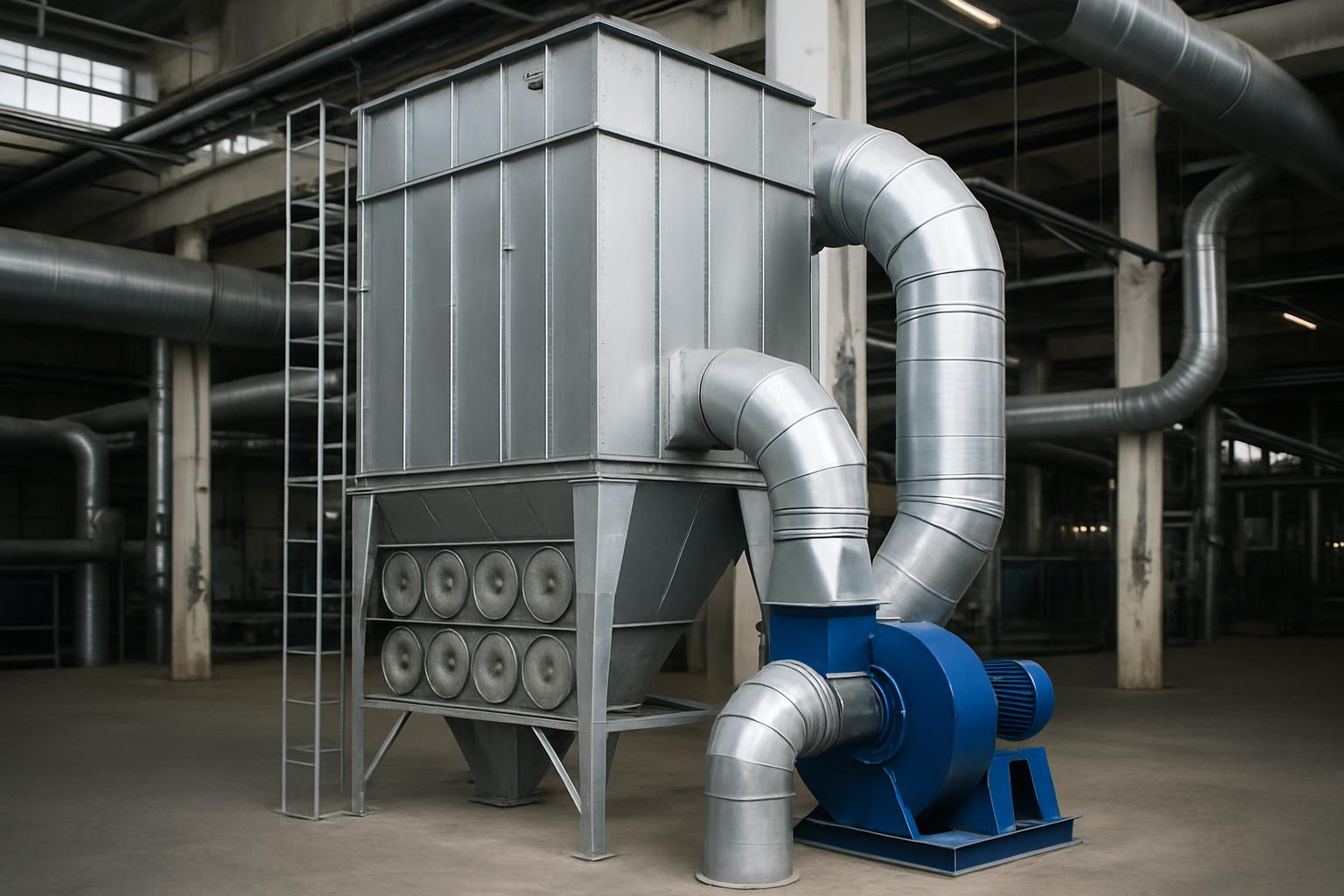
A complete wood dust treatment system will include: individual machine suction hoods, duct networks, pre-treatment Cyclone, fabric filter chamber (baghouse) with cleaning mechanisms, centrifugal fans, discharge ducts, dust discharge - collection units (rotary valves, screw conveyors/chains), control cabinets, differential pressure gauges, and explosion safety devices. The Cyclone body and baghouse shell are usually made from carbon steel such as SS400 or stainless steel in corrosive - humid areas, ensuring mechanical durability and abrasion resistance. Bag materials are selected according to section 3.3; the bag frame is fabricated according to mechanical standards to ensure rigidity and uniform gaps, avoiding tearing.
Regarding the reference power range, commercial configurations of Cyclone - fabric filter equipment show that processing flow can be around 5,500–30,000 m3/h for each module, with Cyclone diameters typically around 800–3,200 mm, and the number of fabric bags ranging from 20–102 bags, with corresponding fan power of approximately 7.5–37 kW. These are typical value ranges to visualize module scale; actual projects will vary according to dust loads, desired efficiency, layout, and module division methods.
In the filter block, the compressed air cleaning mechanism includes an air tank, solenoid valve cluster, manifold, and nozzles placed correctly at the center of each bag row; the controller needs to have a pressure differential mode to optimize the cleaning cycle. The differential pressure gauge installed across the clean - dirty chambers is the “truth sensor” for operators to monitor bag conditions and system losses over time.
5. Operation, Maintenance, and Optimization
Stable operation revolves around maintaining the pressure differential across the baghouse within the target range by regulating the cleaning cycle - intensity. When dust accumulates thickly, the air permeability coefficient decreases, and the pressure differential increases; the controller will activate cleaning according to preset thresholds to restore the filter surface to a ventilated state. When a balanced state is achieved, the cleaning speed - compressed air consumption also stabilizes, helping to save energy and extend bag lifespan. In variable load modes (many machines turning on/off), balancing branch air valves should be adjusted to avoid some bag compartments working excessively while others lack load.
Regular maintenance focuses on: checking for leaks on the shell - inspection doors - seals; cleaning differential pressure sensors; checking the airtightness of the compressed air - pulse valves; lubricating - replacing rotary valve seals; observing bridging phenomena in hoppers; and especially inspecting for tears, holes, or needle holes in the bags. With wood dust containing resin, clumping can cause the filter surface to “clog”; at that point, controlled cleaning pulses should be intensified or consideration should be given to replacing materials with better surface finishes (e.g., PTFE coating). If dust is found leaking into the clean chamber or discharge duct, the machine must be stopped to check the installation of the frame - bag neck - duct plate, as even small leaks can rapidly increase emissions and dirty the fan after filtering.
Optimizing the system is a continuous journey. Differential pressure data - pulse frequency - flow rate - bag cleaning status over time is the “map” for adjustments. With large particle dust, cleaning cycles can be loosened to keep the “dust filter membrane” thin, supporting fine particle performance; with clumping dust, strong - short cleaning should be applied to avoid pressing dust deep into the fabric structure. On the ducts, adjusting branch air valves according to actual production conditions helps balance the system, reducing localized hot spots and aerodynamic noise.
6. Common Errors and Solutions in the Cyclone + Fabric Filter Wood Dust Treatment System
Rapid pressure differentials are a common error. The causes are often insufficient cleaning, resin - moisture clumping on the filter surface, auxiliary air leaks at inspection doors disrupting distribution, or dust returning from the hopper due to loss of “air lock”. The solution is to check - clean the cleaning system, adjust the pressure differential thresholds, reassess bag materials and rotary valve conditions; in many cases, upgrading the bag surface finish helps significantly improve performance.
Clogging - bridging in hoppers occurs when the slope - surface is not suitable for the dust characteristics, or when there are long - fibrous foreign objects causing entanglement. It is necessary to check the hopper angle, install tapping - vibrating devices if needed, add inspection ports, and establish regular cleaning procedures. Do not allow dust to accumulate high enough to touch the bag bottoms as this can easily cause re-entrainment, abrasion, and increase localized pressure differentials. In the Cyclone, if performance declines, check the inlet (dust accumulation, obstructions), leaks on the body, and vortex flow speed - these factors influence centrifugal force.
Dust - fire incidents entering the bag chamber are serious risks. It is necessary to check the spark sources (knife jams, sparks from nearby metalworking), install spark separators, ensure continuity of grounding, and consider equipping fast-reacting explosion suppression systems. When the safety system shows signs of activation or alarm, the root cause must be investigated, not just replacing the activated equipment.
7. Quick Comparison Table and Reference Data
The following table summarizes some typical technical data from publicly available technical sources, used as references when considering configurations for wood dust. The quantitative values are extracted from technical introductions and commercial modules; actual projects need detailed calculations according to specific conditions.
| Criteria | Cyclone (Pre-Treatment) | Fabric Filter (Baghouse) | Combined Cyclone + Fabric Filter System |
|---|---|---|---|
| Efficiency with particles ≥ 10 µm | Approximately 95–98% (according to technical data) | Not specialized for coarse particles; overall efficiency depends on the bags | Optimal: Cyclone handles large particles, fabric filter retains fine particles |
| Overall efficiency for fine dust treatment | Limited with ultrafine particles | Can reach about 99.8% when the right material - cleaning is chosen | Combined system achieves high, stable air quality due to load sharing |
| Example module flow range | Depends on design | Depends on design | Approximately 5,500 – 30,000 m3/h (a commercial configuration) |
| Reference Cyclone diameter | — | — | Approximately 800 – 3,200 mm (according to typical configurations) |
| Reference number of fabric bags | — | — | Approximately 20 – 102 bags (depending on module) |
| Reference fan power | — | — | Approximately 7.5 – 37 kW (depending on flow - resistance) |
| Maximum working temperature of bag materials (reference) | — | Polyester ~150°C; Nomex ~240°C; PPS ~190°C; Acrylic ~120°C | Select according to actual air - thermal load line |
| Explosion suppression system response | — | — | Millisecond level; has a response time system of ~0.001 s for detection - activation |
The above values are real data from technical introductions: Cyclone efficiency of 95–98% with particles ≥10 µm; fabric filter efficiency of about 99.8% when operated correctly; module flow range of 5,500–30,000 m3/h along with typical sizes - number of bags - fan power; temperature limits of bag materials (Polyester, Nomex, PPS, Acrylic); and explosion suppression reaction times at the level of 0.001 s. In actual design, engineers will confirm again through calculations - simulations and field tests.
8. Construction, Acceptance, and Operational Handover
Construction begins with fabricating the Cyclone - baghouse shell according to manufacturing drawings, surface treatment - abrasion-resistant protective painting, assembling the frame - bag rack - duct plate modules. The compressed air cleaning system is installed - adjusted according to the pneumatic diagram: air tank, valves - manifolds, air filters - dryers, control cables to the central cabinet. On the duct, conical - tapered - tee sections are installed according to specifications, ensuring airtightness; air valves - inspection doors are correctly positioned and tested for leaks through pressure - smoke tests.
The trial operation phase begins with a no-load check: measuring vibration - noise of the fan, checking rotation direction, mechanical balancing; then running with dust load and recording pressure differentials - cleaning cycles over time. Adjust the cleaning controller according to pressure differential thresholds, confirm that the rotary valve for dust discharge operates continuously and that the hopper does not bridge. For systems with explosion safety, functional testing (dry) is performed according to the manufacturer's recommendations, ensuring interlocking - alarm operation. Finally, measure the air after filtering according to the internal monitoring plan to compare with output quality targets; when achieved, proceed with handover along with an operation - maintenance manual and spare parts list.
9. Some Design Notes Specific to Wood Dust
Wood dust is fibrous, easily suspended, and wraps around local resistance. Therefore, avoid sharp edges - ridges in ducts and minimize sharp turns. In suction hoods, prioritize “open - hugging” geometry instead of closed “point suction” that causes swirling; ensure ease of cleaning operations. On the Cyclone, choose a stable tangential inlet structure and a sealed dust discharge with a rotary valve to eliminate auxiliary air flows causing dust re-entrainment.
For the fabric filter section, if wood products contain a lot of resin - glue, consider fabrics with good surface finishes and strong - short cleaning pulses. In humid environments, Acrylic has good moisture resistance; when temperatures exceed Polyester limits, switch to Nomex or PPS according to the thermal range of the air line. If improving ultrafine particle capture is needed, PTFE membrane coating helps reduce emissions without significantly increasing filter area. However, any material changes must be accompanied by a review of the cleaning cycle to avoid “over-cleaning”.
10. Conclusion on Implementation Orientation
The Cyclone + fabric filter system is the most suitable “duo” for wood dust: the Cyclone handles coarse - heat - high loads, while the baghouse refines fine particles to achieve stable air quality. The reference values of 95–98% particle separation ≥10 µm in the Cyclone and about 99.8% in the fabric filter show a significant potential to bring treated air to target standards. When accompanied by standard duct - suction hood designs, continuous dust discharge using rotary valves, pressure differential-controlled cleaning, and fast-reacting explosion safety layers in milliseconds, the system not only meets environmental requirements but also remains durable and cost-effective over its lifecycle.
Practical implementation should begin with surveying - sampling dust and describing the operational modes of the plant, followed by preliminary design to estimate modules - main materials, then simulation - fabrication - installation and completing trial runs. Throughout the process, the goal of legal compliance needs to be verified early with applicable documents; at the same time, differential pressure - cleaning cycle - flow data during trial runs are valuable inputs for fine-tuning to the optimal configuration.
FAQ
1) Why should a Cyclone be used before a fabric filter in wood dust treatment?
Wood dust has large particles, high loads, and is prone to clumping; the Cyclone quickly separates particles ≥10 µm with an efficiency of 95–98% (according to technical data), reducing load - wear on the fabric filter. As a result, the fabric filter focuses on fine particles to achieve very high overall efficiency and maintain stable pressure differentials.
2) How high can the fabric filter system achieve filtration efficiency?
Commercial fabric filter systems are reported to achieve efficiencies of about 99.8% if the right materials are chosen and cleaning is operated properly. Controlling pressure differentials through compressed air pulses at thresholds is a key factor in maintaining long-term effectiveness.
3) What criteria should be used when selecting bag materials for hot - humid air?
Base it on the temperature - humidity range and the clumping characteristics of the dust: Polyester works up to about 150°C, Nomex up to about 240°C, PPS around 190°C, and Acrylic around 120°C. For finer filtration requirements or smooth surfaces, PTFE membrane coating is a useful option.
4) Does the explosion safety system really react in time when an incident occurs?
Modern explosion suppression solutions detect pressure increases in milliseconds and have a response time system of about 0.001 seconds. The extinguishing agent discharge mechanism helps cool - cut ignition sources, control pressure, and prevent propagation.
5) Can wood dust be reused after separation?
Dry wood dust can be directed towards reuse as pellets - biomass fuel if the line and risk management are appropriate. However, it is necessary to ensure airtight collection - discharge, safe storage, and compliance with fire prevention requirements in dust storage.
6) What signs indicate that the fabric filter cleaning system is not operating effectively?
Rapid pressure differentials, abnormal cleaning frequencies, dust falling back from the hopper, or dust mixing into the clean chamber are warning signals. When encountering this situation, it is necessary to check bag materials, pressure differential settings, compressed air tightness - pulse valves, and the condition of the dust discharge rotary valve.
Nanoen
NANO THANG LONG ENVIRONMENTAL COMPANY LIMITED
Hanoi Office: No. 15 TT18 Van Phu Urban Area, Ha Dong, Hanoi
Can Tho Office: 661E/29, Vo Van Kiet Street, Binh Yen A Area, Long Hoa Ward, Binh Thuy District, Can Tho City
Ho Chi Minh City Office: 533/12/7, Pham Van Bach Street, Ward 15, Tan Binh District, Ho Chi Minh City
Hotline: 0986.689.781 - 0969.054.226
Email: thanglongnanoen@gmail.com
Facebook: www.facebook.com/thanglongnanoen